
About Chad
French and Arabic - both official languages, used in government and education.
Sara and Sango - widely spoken in the south.
Chad is home to over 200 ethnic groups and more than 100 different languages and dialects overall, making it one of the most linguistically diverse countries in Africa.
French and Arabic are both official languages of Chad.
| Geography |
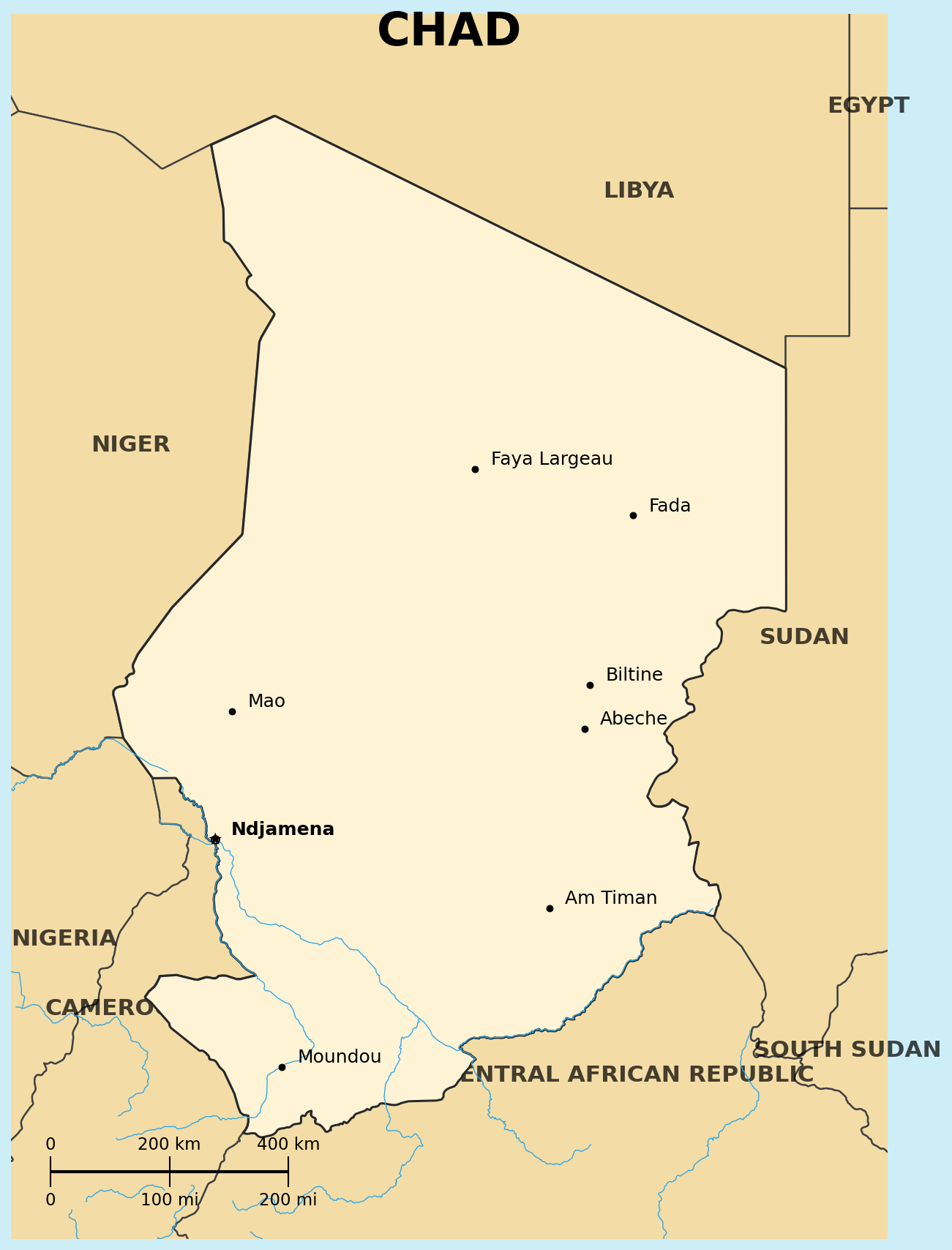
Location: Central Africa, landlocked, south of Libya
Map references: Africa
Area:
total: 1,280,000-1,284,000 sq km (5th largest country in Africa)
Land boundaries:
border countries: Cameroon, Central African Republic, Libya, Niger, Nigeria, Sudan
Geography - note: named for Lake Chad, along the western border, from a local word meaning "large body of water"; the only country whose name is a single syllable with a single vowel
| People |
Population: 17,963,211-19,674,004 (2022-2025 est.)
Age structure:
0-14 years: 47.43%
65 years and over: 2.43% (2022 est.)
Life expectancy at birth:
total population: 53.00 years
male: 51.30 years
female: 54.77 years
Infant mortality rate: 65.48 deaths/1,000 live births
Nationality:
noun/adjective: Chadian(s)
Ethnic groups: over 200 ethnic groups; largest include Sara, Arab, and Kanem-Bornu; northern areas dominated by the Toubou people, Gorane, Zaghawa, Kanembou, and Fulbe; Sahel region populated mostly by Arab Muslim groups including the Maba
Religions: Islam 55.1%, Christianity 41.1%, no religion 2.4%, Animism 1.3% (2020 est.)
Languages: French and Arabic (official); Sara and Sango in the south; more than 100 different languages and dialects spoken overall
Literacy: total population 30.6% (male 44.5%, female 18.6%) (2019 est.)
| Government |
Country name:
conventional long form: Republic of Chad
conventional short form: Chad
local long form: Republique du Tchad/Jumhuriyat Tshad
Data code: CD
Government type: unitary semi-presidential republic under a hereditary dictatorship
National capital: N'Djamena
Executive branch:
chief of state: President Mahamat Idriss DEBY
head of government: Prime Minister Allamaye Halina
Background: shortly after longtime President Idriss DEBY was killed during a rebel incursion in 2021, a group of military officials led by his son Mahamat Idriss DEBY took control of the government, dismissed the National Assembly, and suspended the constitution; a new constitution was promulgated in October 2025 following a session boycotted by some opposition parties; Chad has faced widespread poverty and political instability
| Economy |
Economy - overview: low-income, oil-dependent economy; oil represents around 15% of GDP, 41% of government revenue, and 76% of exports; agriculture accounts for roughly 40% of GDP and supports much of the population, repeatedly affected by droughts, floods, conflict, and displacement; the labor market is largely informal (about 88% of jobs)
GDP (purchasing power parity): $56.65-63.07 billion (2025-2026 est.)
GDP - real growth rate: 1.7% (2025)
GDP - per capita: $2,990 PPP (2025 est.)
Inflation rate: 4.1% (2025 est.)
Unemployment rate: 1.1% (2025 est.)
Population below poverty line: 45.4% (2025 est., rising)
Currency: Central African CFA franc (XAF)