
Country information
Cyprus (Republic of)
- Capital
- Nicosia
- Population
- 983,000
Languages spoken
About Cyprus (Republic of)
Greek - an official language, spoken by more than 80.9% of the population (mainly Greek Cypriots in the south).
Turkish - the other official language, spoken by Turkish Cypriots (mainly in the north, though officially only Greek carries EU-language status).
English, Romanian, Russian, Bulgarian, Arabic, and Filipino are also spoken among minority and immigrant communities.
Greek and Turkish are both official languages of Cyprus.
| Geography |
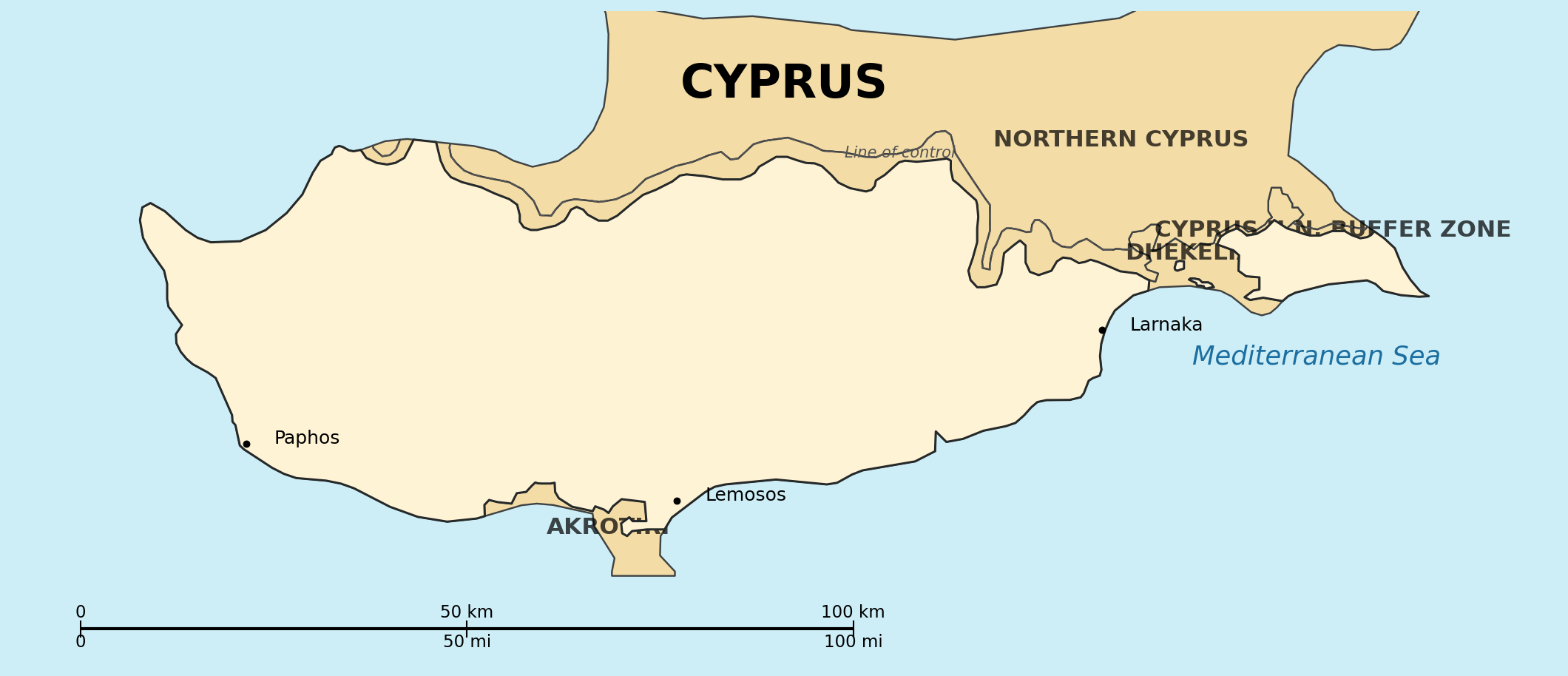
Location: Middle East, an island in the eastern Mediterranean Sea, south of Turkey
Map references: Middle East
Area:
total: 9,251-9,253 sq km
Environment - current issues: scarce water resources; salination; water pollution from sewage, industrial waste, and pesticides; coastal degradation; erosion; loss of wildlife habitats from urbanization
| People |
Population: 979,865-1,332,293 (figures vary depending on treatment of the government-controlled area vs. the Turkish Cypriot-administered area; 2025 est.)
Age structure:
0-14 years: 15.6%
15-64 years: 70%
65 years and over: 14.4% (2024 est.)
Life expectancy at birth:
total population: 80.2-81.6 years
male: 77.4 years
female: 83.1 years
Infant mortality rate: 2.9 deaths/1,000 live births (World Bank, 2025)
Religions: Eastern Orthodox Christian 89.1%, Roman Catholic 2.9%, Protestant/Anglican 2%, Muslim 1.8% (2011 est.; government-controlled area)
Languages: Greek (official), Turkish (official); English, Romanian, Russian, Bulgarian, Arabic, and Filipino also spoken
Population distribution: concentrated in central Nicosia and in the major southern cities of Paphos, Limassol, and Larnaca
| Government |
Country name:
conventional long form: Republic of Cyprus
conventional short form: Cyprus
Data code: CY
Government type: presidential republic
National capital: Nicosia (Lefkosia/Lefkosa) - Europe's last divided capital
Background: a former British colony, Cyprus became independent in 1960 after years of resistance to British rule; the island has been divided since 1974, with the internationally recognized Republic of Cyprus controlling the south and a Turkish Cypriot administration controlling the north; Cyprus joined the EU in 2004 as a de facto divided island, and EU law is suspended in areas outside the Republic's effective control
| Economy |
Economy - overview: services-based, high-income EU island economy; heavy tourism; a recognized financial hub, with its stock exchange serving as an investment bridge between EU and non-EU member countries; sustained growth following recovery of the national banking system
GDP (purchasing power parity): $67.441 billion (2026 est.)
GDP - real growth rate: 3.8% (2025 est.)
GDP - per capita: $67,796 PPP (2026 est.)
Inflation rate: 2.8% (April 2026)
Unemployment rate: 4.9% (2025 est.)
Industries: tourism, food and beverage processing, cement and gypsum, ship repair, textiles, light chemicals, metal products, wood, paper
Currency: Euro (EUR)