
About Gambia
English - the sole official language, used in government, education, and business.
Mandinka is the largest indigenous vernacular, along with Wolof, Fula (Pulaar), and other regional languages including Jola, Serer, and Soninke.
English is the sole official language of the Gambia.
| Geography |
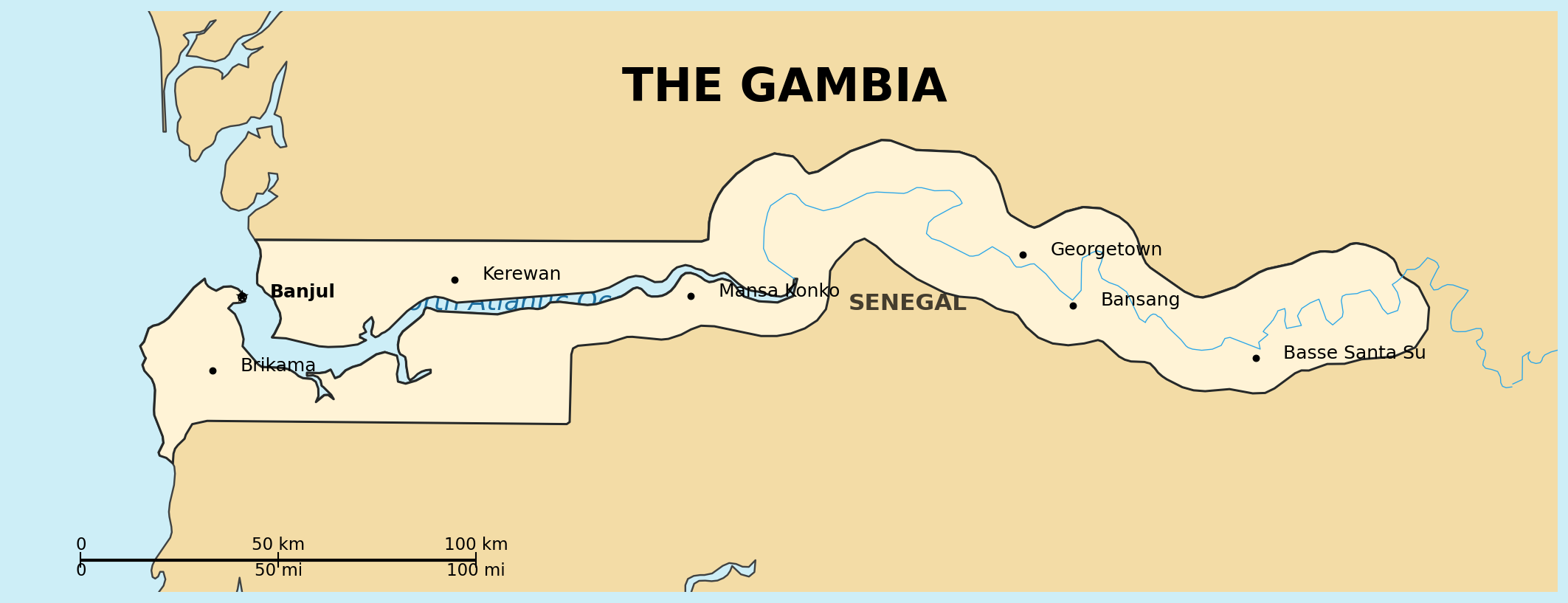
Location: Western Africa, bordering the North Atlantic Ocean and Senegal; Africa's smallest nonisland country, entirely surrounded by Senegal except for its coastline
Map references: Africa
Area:
total: 11,300 sq km
Land boundaries:
border countries: Senegal
Terrain: flood plain of the Gambia River, flanked by low hills; shaped by the Gambia River, which flows east to west, creating fertile plains
Geography - note: almost an enclave of Senegal; boundaries roughly correspond to the Gambia River
| People |
Population: 2,422,712-2,523,327 (2024-2025 est.); one of Africa's most densely populated countries; more than half (57%) live in urban and peri-urban areas
Nationality:
noun/adjective: Gambian(s)
Ethnic groups: Mandinka/Jahanka 33.3%, Fulani/Tukulur/Lorobo 18.2%, Wolof 12.9%, Jola/Karoninka 11%, Serahuleh 7.2%, Serer 3.5%, other 4%, non-Gambian 9.9% (2019-20 est.)
Religions: Muslim 96.4%, Christian 3.5%, other or none 0.1% (2019-20 est.)
Languages: English (official), Mandinka, Wolof, Fula, other indigenous vernaculars
Literacy: total population 51.6% (male 65.3%, female 40.5%) (2021 est.)
Population distribution: settlements scattered along the Gambia River; largest communities, including the capital Banjul and the largest city Serekunda, are at the mouth of the river along the Atlantic coast
| Government |
Country name:
conventional long form: Republic of The Gambia
conventional short form: The Gambia
Data code: GA
Government type: unitary presidential republic
National capital: Banjul
Independence: 18 February 1965 (from the United Kingdom)
Executive branch:
chief of state and head of government: President Adama BARROW (since 19 January 2022)
Background: the 2016 presidential election ended 22 years of autocratic rule under Yahya JAMMEH, ushering in Adama BARROW's administration; the country has since navigated a complex post-dictatorship transition focused on democratic consolidation and constitutional reform, though efforts to replace the 1997 constitution have repeatedly stalled
| Economy |
Economy - overview: low-income West African economy; agriculture-dominant (notably peanut/groundnut production and export); heavily reliant on tourism and remittances; high poverty rate; heightened inflation; dependent on foreign assistance, with structural reforms conditioned by an IMF Extended Credit Facility program
GDP (purchasing power parity): $10.35-11.05 billion (2025-2026 est.)
GDP - real growth rate: 5.9% (2025 est.)
GDP - per capita: $3,690-3,820 PPP (2025-2026 est.)
Inflation rate: 6.5% (2020 est.)
Labor force: 781,558 (2019)
Population below poverty line: 48.6% (2015)
Currency: Gambian dalasi (GMD)
| Military |
Military branches: Gambian Armed Forces (GAF), responsible for external defense and aiding civil authorities during emergencies; has a history of involvement in domestic politics, including multiple coup attempts, most recently an attempted coup in 2022; ECOWAS member states (Ghana, Nigeria, Senegal) provide security forces for stability through the ECOWAS Mission in the Gambia (ECOMIG) (2025)