

About Grenada
English - the sole official language.
French patois (Grenadian Creole, "Patwa") - widely spoken informally, reflecting the island's history of French and later British colonial rule.
English is the sole official language of Grenada.
| Geography |
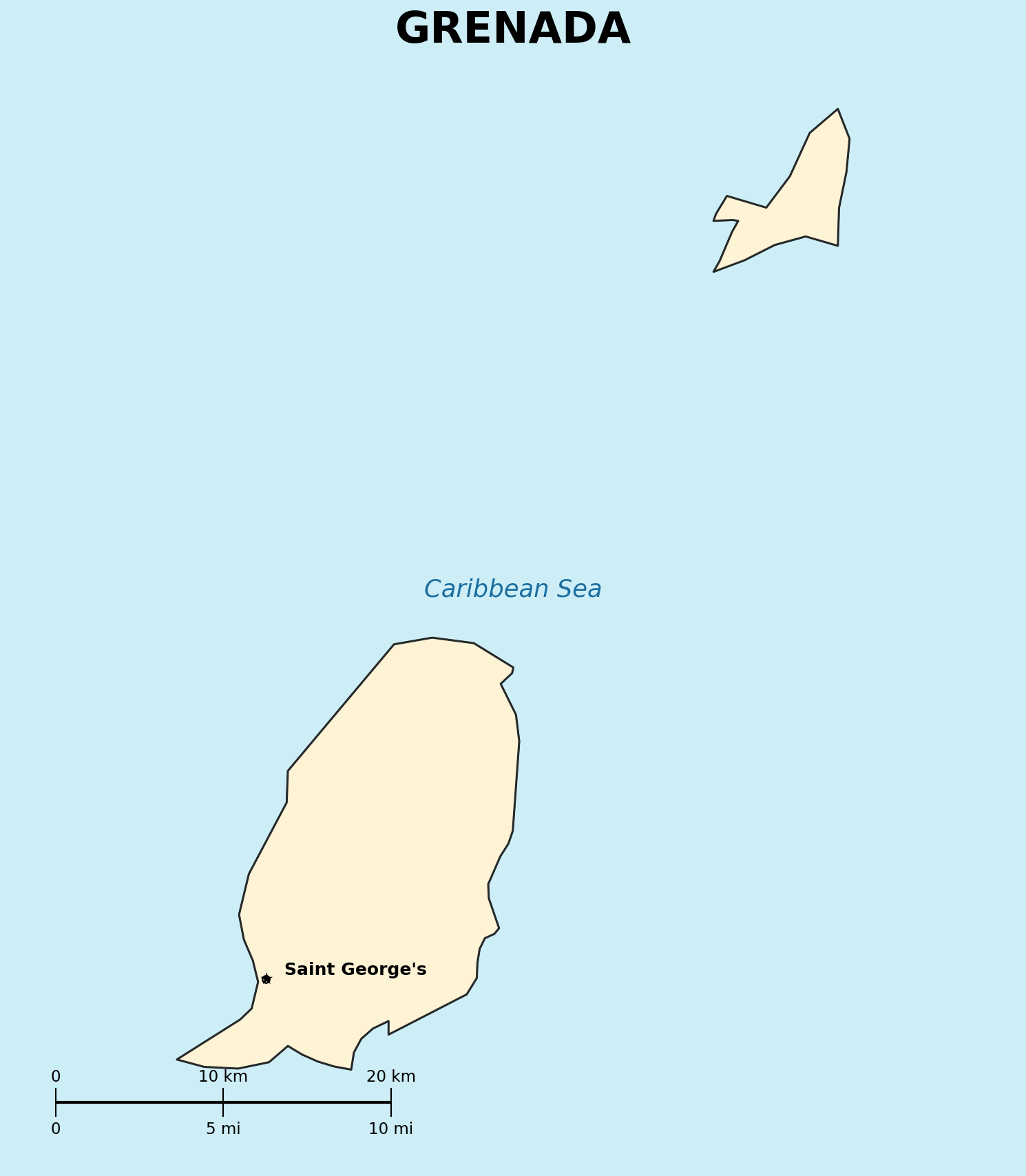
Location: Caribbean, island between the Caribbean Sea and the North Atlantic Ocean, north of Trinidad and Tobago; consists of the main island and six smaller islands
Map references: Central America and the Caribbean
Area:
total: 344 sq km
Environment - current issues: deforestation causing habitat and species loss; coastal erosion and contamination; pollution and inadequate solid waste management
| People |
Population: 112,000-125,438 (varies by source; 2022-2024 est.)
Life expectancy at birth:
total population: 74.9-76.3 years
male: 73.7 years
female: 79.1 years
Infant mortality rate: 14.4 deaths/1,000 live births (2021)
Nationality:
noun/adjective: Grenadian(s)
Religions: Protestant 49.2% (Pentecostal 17.2%, Seventh Day Adventist 13.2%, Anglican 8.5%, others), Roman Catholic 36%, none 5.7% (2011 est.)
Languages: English (official), French patois
Population distribution: urban population approximately 37% of total (2022)
| Government |
Country name:
conventional short form: Grenada; origin of the name is obscure, possibly named for the Spanish city of Granada (Spanish for "pomegranate")
Data code: GJ
Government type: parliamentary democracy under a constitutional monarchy; a Commonwealth realm
National capital: St. George's
Background: the indigenous Carib people inhabited Grenada when Christopher Columbus landed in 1498, though it remained uncolonized for over a century; the French settled the island in the 17th century, establishing sugar estates and importing enslaved Africans; Britain took control in 1762 and expanded sugar production; cacao surpassed sugar as the main export in the 19th century, and nutmeg became the leading export in the 20th century; Britain granted autonomy in 1967, with full independence following in 1974
| Economy |
Economy - overview: small Caribbean island economy; one of the world's largest exporters of nutmeg and mace; agriculture (spices), tourism, and light manufacturing are key sectors
GDP (purchasing power parity): $1.39-2.13 billion (varies by source/year)
GDP - real growth rate: 5.8% (2022)
GDP - per capita: $16,987 PPP (2022)
Industries: food and beverages, textiles, light assembly operations, tourism
Currency: East Caribbean dollar (XCD)
| Military |
Military - note: no regular military forces; the Royal Grenada Police Force includes a Coast Guard and a paramilitary Special Services Unit; Grenada joined the Caribbean Regional Security System (RSS) in 1985, alongside Antigua and Barbuda, Barbados, Dominica, Guyana, St. Kitts and Nevis, St. Lucia, and St. Vincent and the Grenadines (2025)