
Country information
Guatemala
- Capital
- Guatemala City
- Population
- 18,312,373
Languages spoken
About Guatemala
Spanish - the official language, spoken by ~69.9% of the population.
Maya languages - spoken by ~29.7% of the population, including Q'eqchi' (~8.3%), K'iche (~7.8%), Mam (~4.4%), Kaqchikel (~3%), and Q'anjob'al (~1.2%).
Xinca and Garifuna are also spoken by smaller communities; the 2003 Law of National Languages officially recognizes 23 indigenous languages, including 21 Maya languages, Xinca, and Garifuna.
Spanish is the official language of Guatemala, alongside 23 officially recognized indigenous languages.
| Geography |
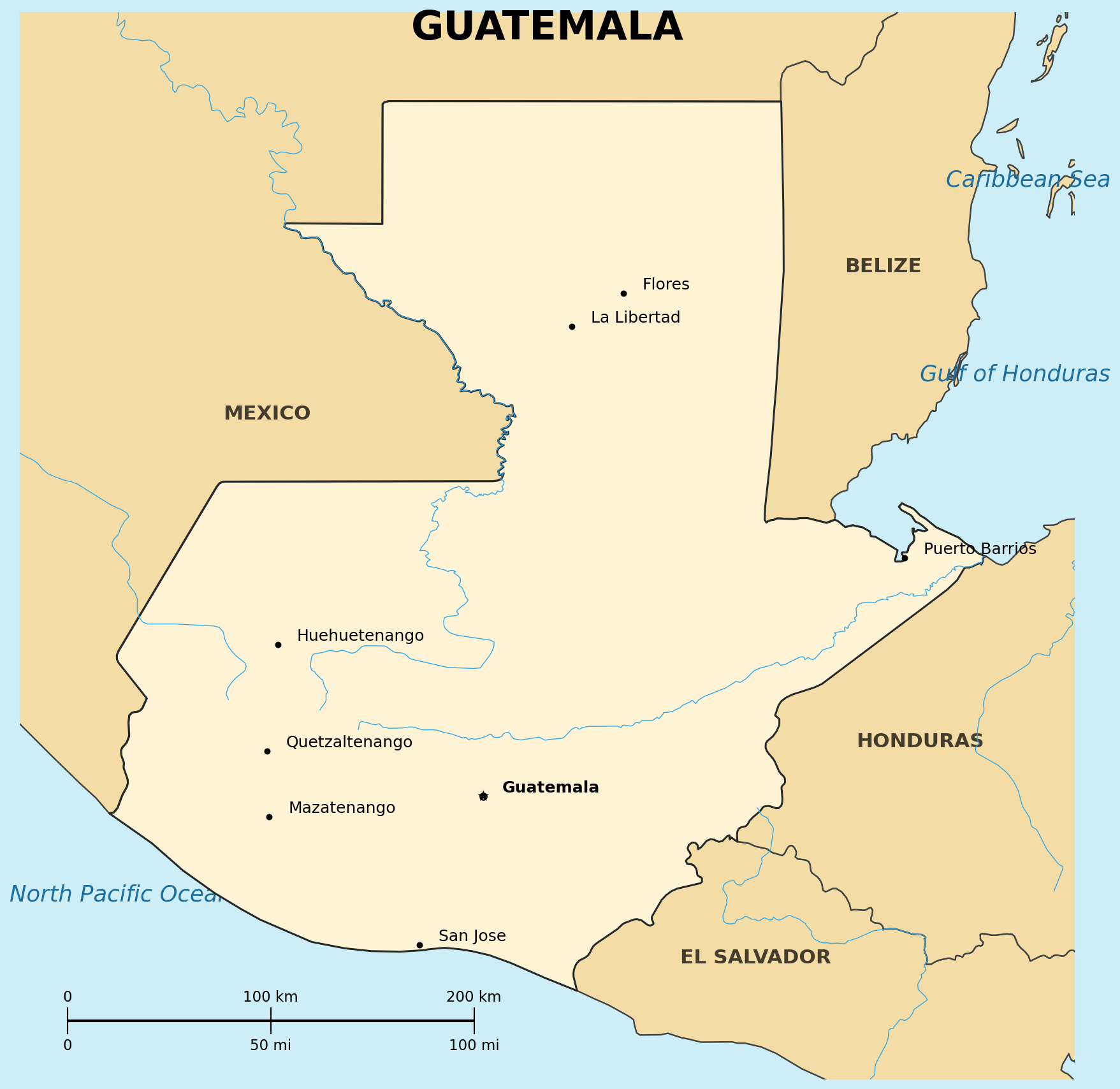
Location: Central America, bordering both the North Pacific Ocean and the Caribbean Sea, between El Salvador, Honduras, and Mexico
Map references: Central America and the Caribbean
Area:
total: 108,889 sq km
Land boundaries:
border countries: Belize, El Salvador, Honduras, Mexico
Natural hazards: numerous volcanoes in mountains, with frequent violent earthquakes; Guatemala lies along the Pacific Ring of Fire
Geography - note: despite having both eastern and western coastlines, there are no natural harbors on the west coast
| People |
Population: 18,255,216-19,357,426 (2023-2025 est.); most populous country in Central America; highest fertility and population growth rates in Latin America; almost half the population is under age 19
Age structure:
0-14 years: 31.5-32.74%
15-64 years: 61.95-63.2%
65 years and over: 5.31-5.4%
Life expectancy at birth:
total population: 72.91 years
male: 70.88 years
female: 75.04 years
Infant mortality rate: 26.18 deaths/1,000 live births
Nationality:
noun/adjective: Guatemalan(s)
Ethnic groups: Mestizo/Ladino 56%, Maya 41.7%, Xinca 1.8%, other 0.5% (2018 est.)
Religions: Evangelical 45.7%, Roman Catholic 42.4%, none 11% (2023 est.)
Languages: Spanish (official) 69.9%, Maya languages 29.7%, other 0.4% (2018 est.)
Literacy: total population 82.1% (male 86.9%, female 78.5%) (2024 est.)
Population distribution: the vast majority resides in the southern half of the country, particularly the mountainous regions; more than half the population lives in rural areas
| Government |
Country name:
conventional long form: Republic of Guatemala
conventional short form: Guatemala
Data code: GT
Government type: presidential republic
National capital: Guatemala City
Independence: 15 September 1821 (from Spain); 17 April 1839 (from the Federal Republic of Central America)
| Economy |
Economy - overview: upper-middle-income, developing economy; a predominantly poor country struggling with infant/child/maternal mortality, malnutrition, and literacy, disproportionately affecting the large indigenous population; heavily dependent on remittances (about 19% of GDP), largely from the US
GDP (purchasing power parity): $278.508-303.02 billion (2025-2026 est.)
GDP - real growth rate: 3.9% (2026)
GDP - per capita: $15,386-16,021 PPP (2025-2026 est.)
Inflation rate: 4.2% (2020 est.)
Unemployment rate: 2.6% (2025 est.)
Population below poverty line: 56% (2023)
Currency: Guatemalan quetzal (GTQ)
| Military |
Military branches: Army of Guatemala (Ejercito de Guatemala): Land Forces, Naval Forces, Air Force (2025)
| Transnational Issues |
Illicit drugs: major transit country for cocaine and heroin destined for the US market; proximity to Mexico makes Guatemala a major staging area for drug trafficking; money laundering and corruption remain serious problems