
About Guinea
French - the official language, a legacy of colonial rule.
Pular, Maninka, and Susu - the most widely spoken native languages.
About 40 languages are spoken across Guinea's ethnic groups, each with its own language.
French is the sole official language of Guinea.
| Geography |
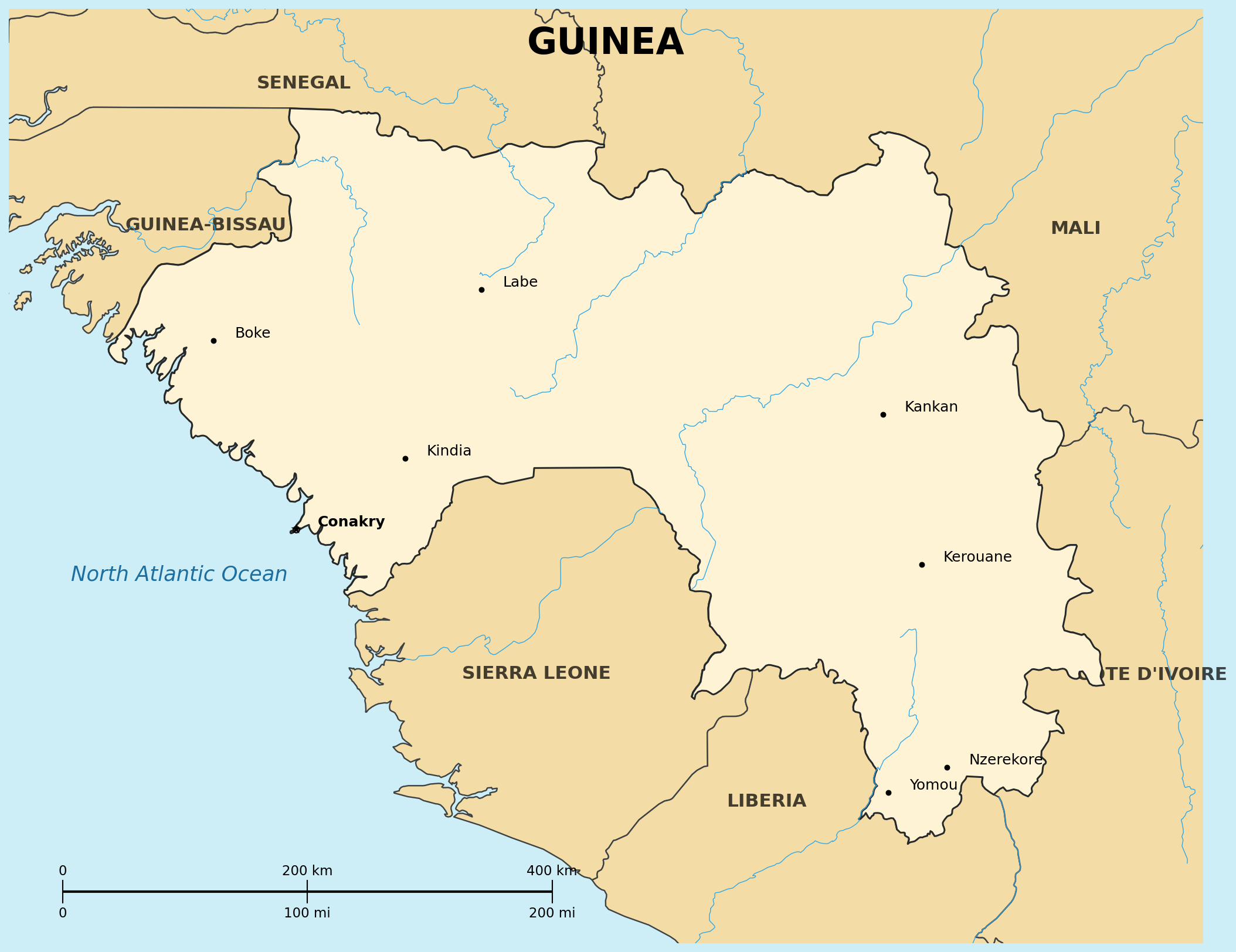
Location: Western Africa, bordering the North Atlantic Ocean, between Guinea-Bissau and Sierra Leone
Map references: Africa
Area:
total: 245,857 sq km
Land boundaries:
border countries: Cote d'Ivoire, Guinea-Bissau, Liberia, Mali, Senegal, Sierra Leone
Geography - note: named after the Guinea region of West Africa along the Gulf of Guinea; the name itself derives from the Tuareg word aginaw, meaning "black people"; three of West Africa's major rivers - the Gambia, Niger, and Senegal - rise in Guinea
| People |
Population: 13,986,179-14,374,590 (2024-2025 est.)
Nationality:
noun/adjective: Guinean(s)
Ethnic groups: Fulani (Peuhl) 33.4% (concentrated in the mountainous Fouta Djallon region), Malinke 29.4%, Susu 21.2%, Guerze 7.8%, Kissi 6.2%, Toma 1.6% (2018 est.)
Religions: Muslim 89.1%, Christian 6.8%, animist 1.6%, none 2.4% (2014 est.)
Languages: French (official), Pular, Maninka, Susu, other native languages; about 40 languages spoken overall
Literacy: total population 39.6% (male 54.4%, female 27.7%) (2018 est.)
| Government |
Country name:
conventional long form: Republic of Guinea
conventional short form: Guinea
Data code: GV
Government type: presidential republic (transitioning from military rule)
National capital: Conakry
Executive branch:
chief of state: President Col. Mamady DOUMBOUYA (since 17 January 2026)
head of government: Prime Minister Amadou Oury Bah
Background: formerly French Guinea, part of French West Africa until independence in 1958; ruled successively by Sekou Toure (1958-1984) and Lansana Conte (1984-2008, seized power via coup); held its first free presidential election in 2010 and first free legislative elections in 2013; Alpha Conde was deposed in a military coup on 5 September 2021, led by Col. Mamady Doumbouya, who suspended the constitution and dissolved government institutions; a new constitution was approved by referendum in September 2025, and Doumbouya was elected president in December 2025, taking office in January 2026
| Economy |
Economy - overview: low-income economy dependent largely on agriculture and other rural activities, though endowed with vast mineral wealth; possesses a large portion of the world's bauxite reserves and significant iron, gold, and diamond deposits; economic growth strongly tied to mining, including the major Simandou iron ore project
GDP (purchasing power parity): $75.05 billion (2025 est.)
GDP - real growth rate: 7.1% (2025)
GDP - per capita: $4,075-4,750 PPP (2025 est.)
Unemployment rate: 5.2-5.3% (2024-2025)
Currency: Guinean franc (GNF)
| Military |
Military branches: Guinean (National) Armed Forces: Army, Air Force, Navy, National Gendarmerie; Ministry of Security: National Police (2025)