
Country information
Guinea Bissau
- Capital
- Bissau
- Population
- 1,852,784
Languages spoken
About Guinea Bissau
Portuguese-based Creole (Crioulo) - the lingua franca, widely spoken especially in rural areas.
Portuguese - the official language, though largely used as a second or third language.
Pular (a Fula language) and Mandingo are also spoken.
Portuguese is the sole official language of Guinea-Bissau, while Crioulo serves as the lingua franca.
| Geography |
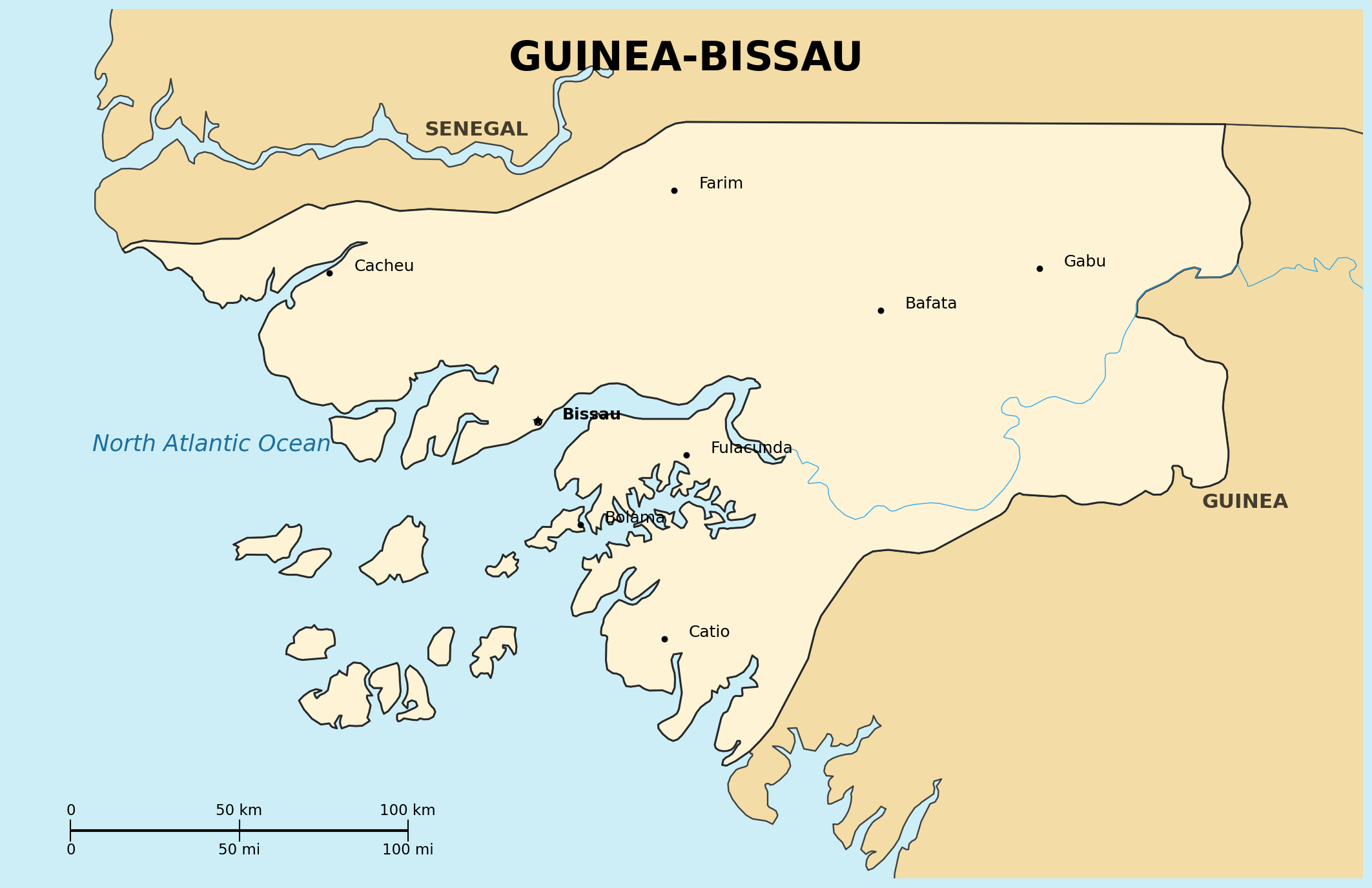
Location: Western Africa, bordering the North Atlantic Ocean, between Guinea and Senegal; includes the Bijagos archipelago and other coastal islands
Map references: Africa
Area:
total: 36,125 sq km
Land boundaries:
border countries: Guinea, Senegal
| People |
Population: 2,026,778-2,132,325 (2022-2024 est.)
Age structure:
0-14 years: 42.3-43.17%
65 years and over: 3.08-3.1%
Life expectancy at birth:
total population: 63.68 years
male: 61.45 years
female: 65.99 years
Infant mortality rate: 49.05 deaths/1,000 live births
Nationality:
noun/adjective: Bissau-Guinean(s)
Ethnic groups: more than 20 ethnic groups; Balanta 30%, Fulani 30%, Manjaco 14%, Mandinga 13%, Papel 7% (2015 est.)
Religions: Muslim 45.1-46.1%, folk religions/animist 14.9-30.6%, Christian 18.9-22.1% (varies by source)
Languages: Portuguese-based Creole (lingua franca), Portuguese (official, second/third language), Pular, Mandingo
Population distribution: about one-fifth of the population lives in the capital, Bissau, along the Atlantic coast; the remainder is distributed among eight mostly rural regions
| Government |
Country name:
conventional short form: Guinea-Bissau; the name derives from the local Bijuga people, distinguishing it from neighboring Guinea
Data code: PU
Government type: in transition following a November 2025 military coup
National capital: Bissau
Administrative divisions: 9 regions
Executive branch:
chief of state: Interim President Gen. Horta Nta Na Man (since 27 November 2025)
Background: the Mali Empire and Kingdom of Kaabu disintegrated into smaller entities from the 18th century; Portugal fully incorporated the territory by the 19th century; gained independence in 1974 after a war of independence (1963-1974); has experienced considerable political and military upheaval since, including a 1980 coup establishing General Joao Bernardo "Nino" Vieira, a 1998-99 civil war, and numerous coup attempts (among the most coup-prone countries in the world); a military coup on 26 November 2025 deposed President Umaro Sissoco Embalo and installed a one-year transitional administration
| Economy |
Economy - overview: low-income, least-developed economy heavily dependent on cashew exports and subsistence agriculture; political instability, weak institutions, and a history of coups have hindered development; economy expanded strongly in 2025, driven by a favorable cashew campaign
GDP (purchasing power parity): $6.62 billion (2025 est.)
GDP - real growth rate: 5.1% (2025)
GDP - per capita: $3,280 PPP (2025 est.)
Unemployment rate: 6.7% (2025 est.)
Population below poverty line: 67% on less than $2/day (2015)
Currency: West African CFA franc (XOF)
| Military |
Military branches: Armed Forces (FARP), focused on external security but also holding internal security duties; the FARP and paramilitary National Guard have historically been influential in the country's politics and have attempted several coups (2025)