
About Hungary
Hungarian (Magyar) - the sole official language, spoken by ~98.8% of the population.
English is spoken as a second language by ~25.3%, German by ~12.6%, and Russian, French, and Romanian by smaller percentages.
Hungarian is a Uralic language, distinct from most of its Indo-European neighbors.
Hungarian is the sole official language of Hungary.
| Geography |
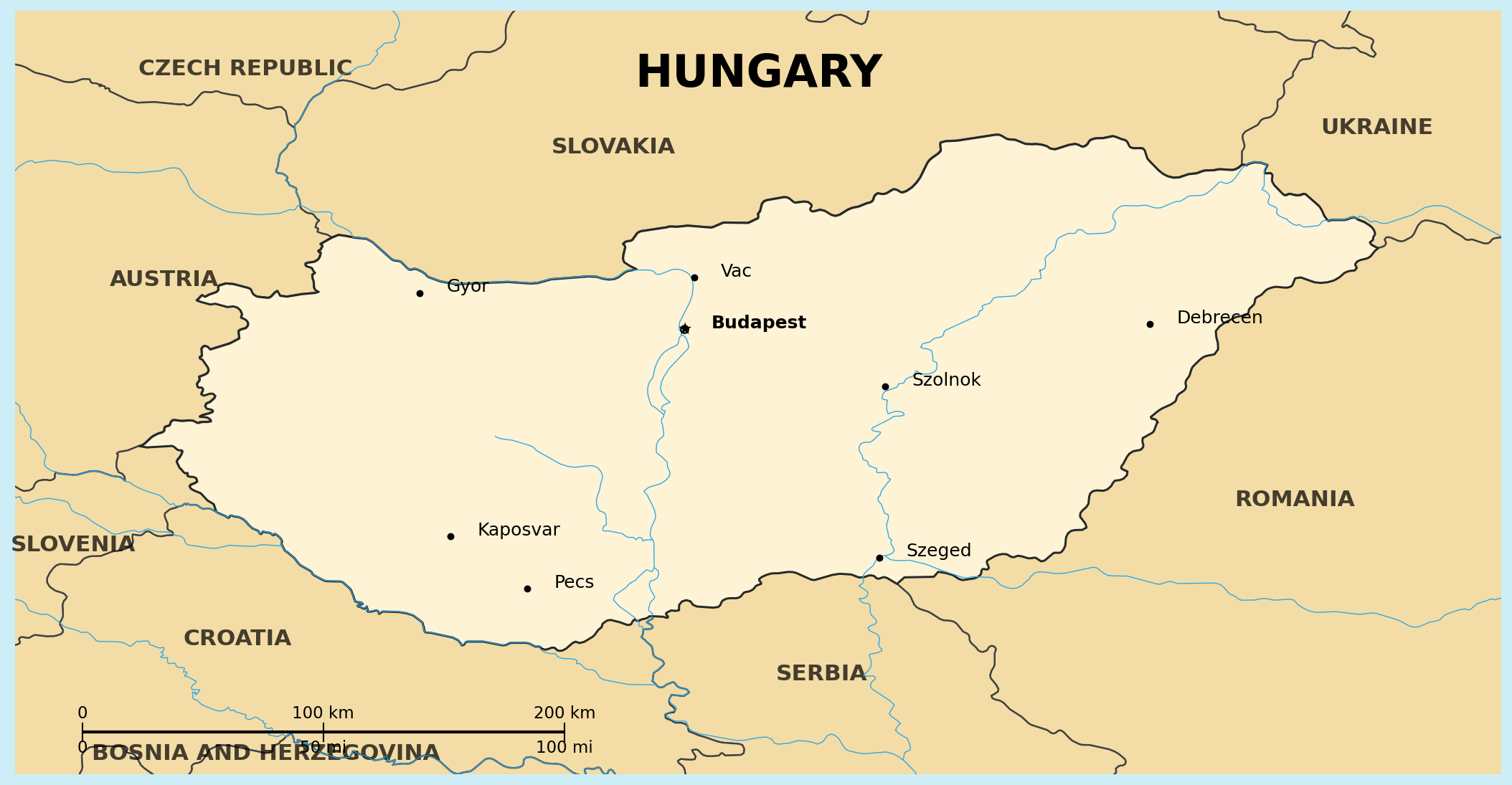
Location: Central Europe, landlocked, northwest of Romania
Map references: Europe
Area:
total: 93,028 sq km
Land boundaries:
border countries: Austria, Croatia, Romania, Serbia, Slovakia, Slovenia, Ukraine
Coastline: 0 km (landlocked)
| People |
Population: 9,640,749-9,855,745 (2024 est.)
Age structure:
0-14 years: 14.6%
15-64 years: 63.9%
65 years and over: 21.5% (2024 est.)
Median age: 45.1 years (2025 est.)
Infant mortality rate: 4.6 deaths/1,000 live births (2025 est.)
Nationality:
noun/adjective: Hungarian(s)
Ethnic groups: Hungarian 84.3%, Romani 2.1%, German 1%, other 1.2%, unspecified 13.7% (2022 est.); note - Romani populations usually underestimated and may represent 5-10% of the population
Religions: Catholic 30.1% (Roman Catholic 27.5%, Greek Catholic 1.7%), Calvinist 9.8%, Lutheran 1.8%, other Christian 1.6%, none 16.1%, no answer 40.1% (2022 est.)
Languages: Hungarian (official) 98.8%, English 25.3%, German 12.6%, Russian 2.1%, French 1.5%, Romanian 1.4%, other 5.1% (2022 est.)
Population distribution: fairly even distribution throughout most of the country, with urban areas attracting larger and denser populations
| Government |
Country name:
conventional short form: Hungary
local short form: Magyarorszag
Data code: HU
Government type: parliamentary republic
National capital: Budapest
Background: Hungary became a Christian kingdom in AD 1000 and for many centuries served as a bulwark against Ottoman Turkish expansion in Europe; became part of the Austro-Hungarian Empire, which collapsed during WWI; fell under communist rule after WWII; in 1956, Moscow crushed a Hungarian revolt with military intervention; under Janos KADAR from 1968, Hungary began liberalizing its economy ("Goulash Communism"); joined the EU in 2004
| Economy |
Economy - overview: high-income EU and OECD economy; modest recovery following a 2023 contraction; strong industrial and automotive manufacturing base
GDP (purchasing power parity): $460 billion (2025)
GDP - real growth rate: 2.2% (2024)
GDP - per capita: $50,780 PPP (2025)
Inflation rate: 5.20% (2024)
Unemployment rate: 4.5% (2025 est.)
Labor force: 4,715,000 (2020)
Population below poverty line: 12.3% (2018)
Industries: mining, metallurgy, construction materials, food processing, electronics, textiles, chemicals, pharmaceuticals, motor vehicles, information technology
Exports: $159.778 billion (2024); machinery and equipment (53.5%), other manufactures, food products
Currency: Hungarian forint (HUF)
| Military |
Military branches: Hungarian Defense Forces (HDF/Magyar Honvedseg): joint force under a general staff with commands for land, air, cyber, special operations, territorial defense, and support forces (2025)