
About Ireland
English - an official language and the language generally used by the population.
Irish (Gaelic/Gaeilge) - also an official language, spoken by approximately 37.7% of the population as of 2022; mainly spoken in areas along Ireland's western coast known as the Gaeltachtai, officially recognized regions where Irish is the predominant language.
Both English and Irish are official languages of Ireland.
| Geography |
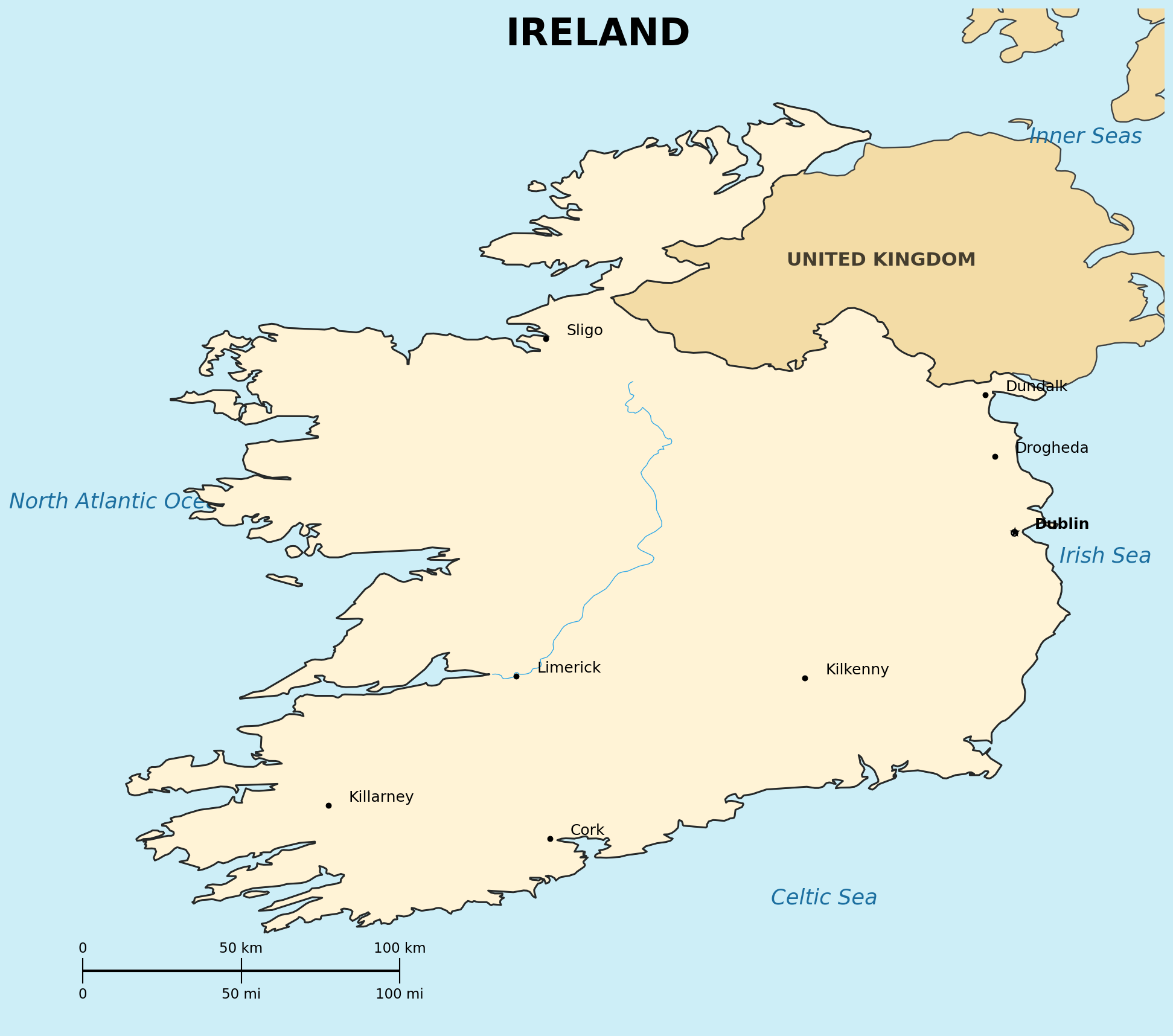
Location: Western Europe, occupying five-sixths of the island of Ireland in the North Atlantic Ocean, west of Great Britain
Map references: Europe
Area:
total: 70,273 sq km
Land boundaries:
border countries: United Kingdom
| People |
Population: 5,233,461-5,323,991 (2023-2024 est.)
Age structure:
0-14 years: 18.6-20.4%
15-64 years: 65.04-65.5%
65 years and over: 14.57-15.8%
Median age: 40.5 years (2025 est.)
Nationality:
noun: Irishman(men), Irishwoman(women), Irish (collective plural)
adjective: Irish
Ethnic groups: Irish 76.6%, Irish travelers 0.6%, other White 9.9%, Asian 3.3%, Black 1.5%, other 2% (2022 est.)
Religions: Roman Catholic 68.3-69.2%, Protestant 3.7-3.8%, Orthodox 2%, Muslim 1.4-1.6%, none 14.5-15.4% (2022 est.)
Languages: English (official, generally used), Irish/Gaeilge (official, ~37.7% of population)
| Government |
Country name:
conventional short form: Ireland
local short form: Eire
Data code: EI
Government type: parliamentary republic
National capital: Dublin
Background: Celtic tribes arrived between 600 and 150 BC; Norse invasions beginning in the late 8th century ended when King Brian Boru defeated the Danes in 1014; Norman invasions began in the 12th century, setting off more than seven centuries of Anglo-Irish struggle; the Irish famine of the mid-19th century caused an almost 25% decline in the island's population through starvation, disease, and emigration; Ireland declared itself a republic in 1949, formally leaving the British Dominion; deep sectarian divides in Northern Ireland erupted into decades of violence known as the Troubles, ending with the 1998 Belfast/Good Friday Agreement
| Economy |
Economy - overview: advanced, high-income EU and Eurozone economy; among the highest GDP per capita in the world, heavily influenced by multinational corporate presence (particularly tech and pharmaceutical); the Celtic Tiger boom years (1995-2007) transformed Ireland into a wealthy, modern economy
GDP (purchasing power parity): $720.31 billion (2025 est.)
GDP - real growth rate: 2.3% (2025f)
GDP - per capita: $133,550 PPP (2025 est.) - among the highest in the world
Inflation rate: 1.7% (2024f)
Unemployment rate: 4.6% (2025 est.)
Population below poverty line: 6.7% consistent poverty (2017); 19.2% at risk of poverty or social exclusion (2023)
Currency: Euro (EUR)
| Military |
Military branches: Irish Defense Forces (Oglaigh na h-Eireann): Army, Air Corps, Naval Service, Reserve Defense Forces (2025)
Military - note: contributes troops to UNIFIL in Lebanon and small numbers to EU, NATO, and other UN peacekeeping missions (2025)