
About Italy
Italian - the official language, spoken by nearly the entire population.
German is predominant in parts of the Trentino-Alto Adige region; French is spoken by a small minority in the Valle d'Aosta region.
Slovene is spoken in the Trieste-Gorizia area, and Croatian is spoken in Molise.
Italian is the sole official language of Italy nationwide.
| Geography |
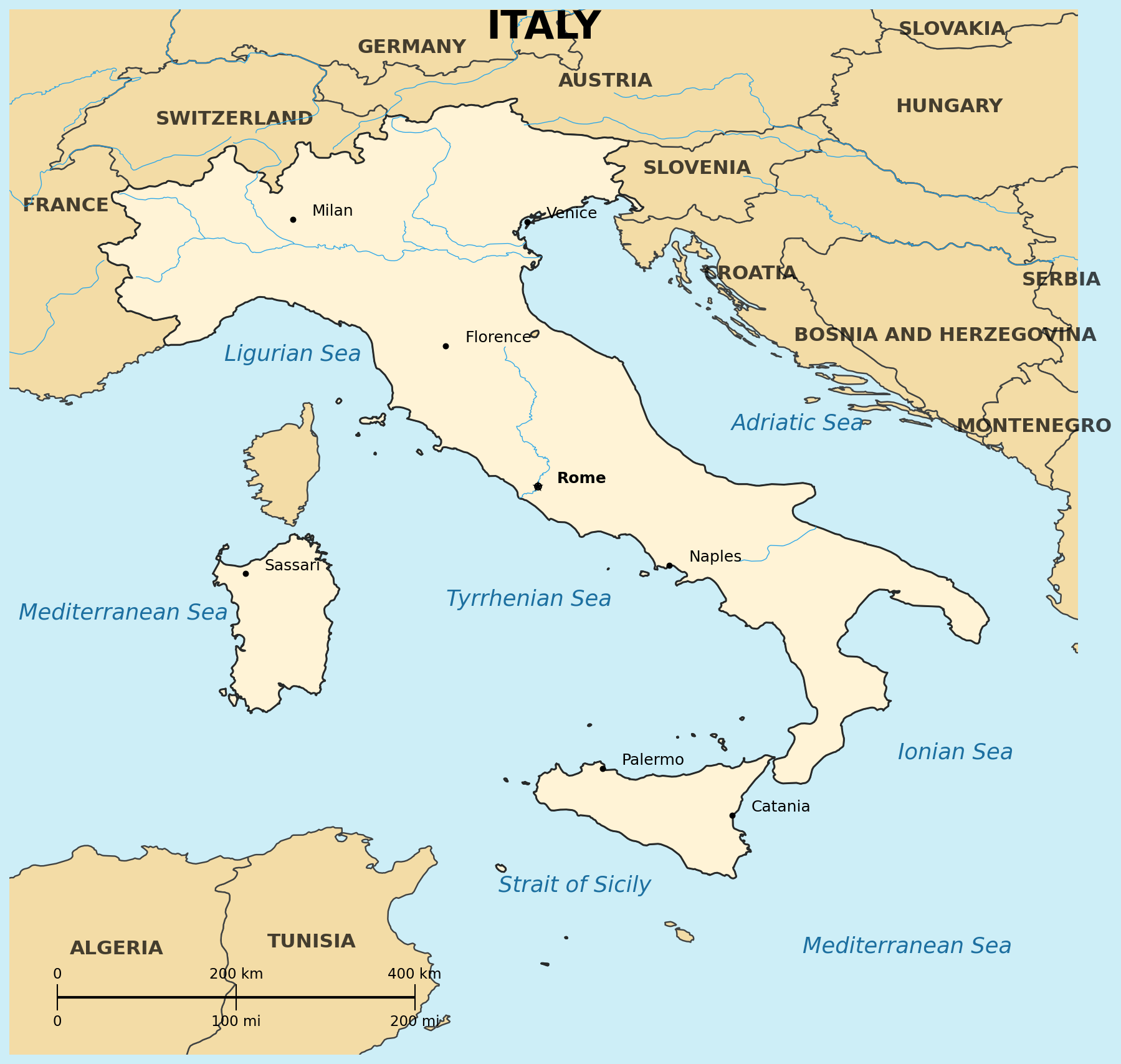
Location: Southern Europe, a peninsula extending into the central Mediterranean Sea, northeast of Tunisia
Map references: Europe
Area:
total: 301,336-301,340 sq km
Land boundaries:
border countries: Austria, France, Holy See (Vatican City), San Marino, Slovenia, Switzerland
| People |
Population: 58,915,561-60,924,851 (2025 est.)
Age structure:
0-14 years: 12.89%
15-64 years: 63.57%
65 years and over: 23.54%
Life expectancy at birth:
total population: 83.4-83.7 years
male: 81.4 years
female: 85.5 years (2024)
Infant mortality rate: 3 deaths/1,000 live births (2025 est.)
Nationality:
noun/adjective: Italian(s)
Ethnic groups: Italian 89.9% (native); Romanian, Albanian, Moroccan, Ukrainian, German, Chinese, and other minorities
Languages: Italian (official); German (parts of Trentino-Alto Adige), French (small minority in Valle d'Aosta), Slovene (Trieste-Gorizia area), Croatian (Molise)
Population distribution: fairly even distribution throughout most of the country, with coastal areas, the Po River Valley, and urban centers (particularly Milan, Rome, and Naples) attracting larger and denser populations
Major urban areas: 4.316 million Rome (capital), 3.155 million Milan, 2.179 million Naples, 1.802 million Turin (2023)
| Government |
Country name:
conventional long form: Italian Republic
conventional short form: Italy
Data code: IT
Government type: parliamentary republic
National capital: Rome
Executive branch:
chief of state: President Sergio MATTARELLA (since 3 February 2015)
head of government: Prime Minister Giorgia MELONI (since 22 October 2022)
Background: became a nation-state in 1861 when regional states, along with Sardinia and Sicily, were united under King Victor Emmanuel II; parliamentary government ended in the early 1920s when Benito Mussolini established a Fascist dictatorship; alliance with Nazi Germany led to defeat in WWII; a democratic republic replaced the monarchy in 1946; a charter member of NATO and the EEC/EU, joining the Economic and Monetary Union in 1999
| Economy |
Economy - overview: high-income, core EU and Eurozone economy; strong services, manufacturing, and tourism sectors; modest growth supported by net exports, low inflation, and public investment; persistent problems include sluggish growth and high youth and female unemployment
GDP (purchasing power parity): $3.967 trillion (2026 est.)
GDP - real growth rate: 0.7% (2024)
GDP - per capita: $65,600 PPP (2026 est.)
Inflation rate: 4.5% (2023)
Population below poverty line: 9.4% (2021)
Currency: Euro (EUR)
| Military |
Military service age and obligation: 17-18 years of age for voluntary service, men and women; minimum 12-month service with option to extend; conscription abolished in 2004 (2025)