
About Romania
Romanian - the sole official language, spoken by the vast majority of the population.
Hungarian is spoken by a significant minority (~6%), and Romani (~3.4%) by another minority group.
Romanian is the sole official language of Romania.
| Geography |
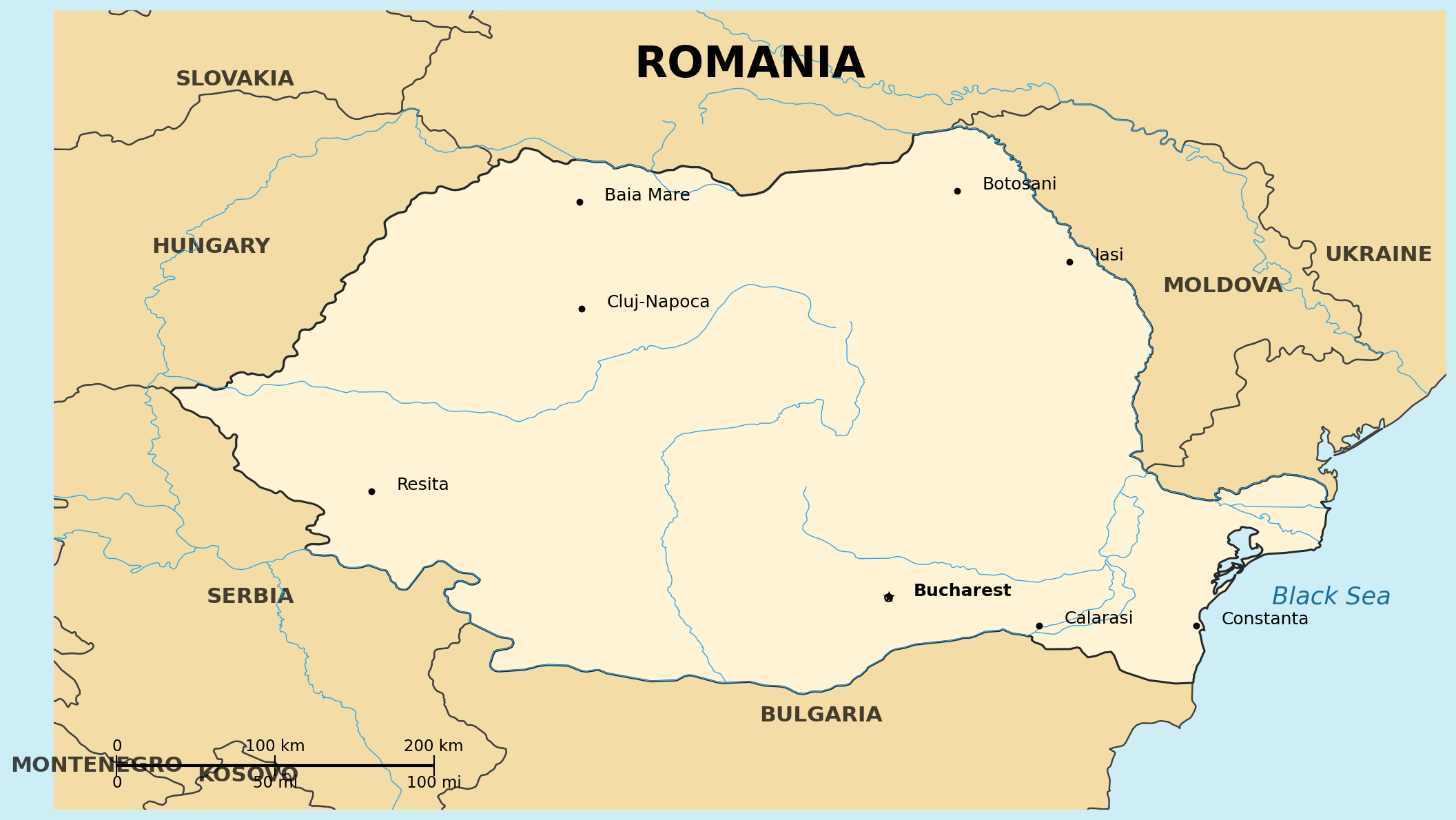
Location: Southeastern Europe, bordering the Black Sea, between Bulgaria and Ukraine
Map references: Europe
Area:
total: 238,391-238,397 sq km
Land boundaries:
border countries: Bulgaria, Hungary, Moldova, Serbia, Ukraine
Terrain: mainly rolling, fertile plains; hilly in the eastern regions of the middle Danube basin; major mountain ranges (the Carpathians) running north and west through the center of the country
Climate: temperate-continental, four seasons, cold winters with frequent snow, sunny summers
| People |
Population: 18,148,155-19,043,151 (2024-2025 est.)
Age structure:
0-14 years: 15.4-16.1%
15-64 years: 62-64.3%
65 years and over: 19.6-22.6%
Life expectancy at birth:
total population: 76.6 years
male: 72.9 years
female: 80.5 years (2023)
Infant mortality rate: 5.6 deaths/1,000 live births (2023)
Nationality:
noun/adjective: Romanian(s)
Ethnic groups: Romanian 89.3%, Hungarian 6.0%, Roma 3.4%, other 1.2-1.4% (2021 census)
Religions: Romanian Orthodox 73.6-85.3%, Protestant/Reformed 5-6.4%, Roman Catholic 4.4-4.5%, Pentecostal 2.5%, no religion 0.8% (2021 census)
Languages: Romanian (official)
Population distribution: urbanization is not particularly high; population distribution is fairly even throughout most of the country, with urban areas attracting larger and denser populations
| Government |
Country name:
conventional short form: Romania
Data code: RO
Government type: unitary semi-presidential republic
National capital: Bucharest
Executive branch:
chief of state: President Nicusor DAN (elected 2025 in runoff)
head of government: Prime Minister Ilie BOLOJAN
Background: underwent a revolution in December 1989, resulting in the execution of communist leader Nicolae CEAUSESCU and the adoption of democracy; former communists continued to control the government until the mid-1990s, when they lost power; joined NATO in 2004 and the EU in 2007
| Economy |
Economy - overview: high-income, developing EU economy with a free-market system and mostly privatized industrial and agricultural sectors
GDP (purchasing power parity): $949-950 billion (2026 est.)
GDP - real growth rate: 0.9% (2025)
GDP - per capita: $50,750-50,783 PPP (2026 est.)
Inflation rate: 8.5% (2025)
Unemployment rate: 5.9-6.0% (2025)
Labor force: 7.742 million (2025)
Population below poverty line: 21.1% (2022)
Industries: electric machinery and equipment, auto assembly, textiles and footwear, light machinery, metallurgy, chemicals, food processing, petroleum refining, mining, timber, construction materials
Exports: $100.31 billion (2024)
Currency: Romanian leu (RON)