
About South Africa
IsiZulu (Zulu) - the most widely spoken official language, ~25.3% of the population.
IsiXhosa (Xhosa) - ~14.8%, Afrikaans - ~12.2%, Sepedi/Pedi - ~10.1%, Setswana/Tswana - ~9.1%, English - ~8.1%, Sesotho/Sotho - ~7.9%, Xitsonga/Tsonga - ~3.6%, siSwati/Swati - ~2.8%, Tshivenda/Venda - ~2.5%, and isiNdebele/Ndebele - ~1.6%.
South African Sign Language and various Khoi/Khoisan/Khoe languages are also spoken.
South Africa has 12 official languages - the most of any country in Africa - reflecting its extraordinary linguistic diversity as the "Rainbow Nation."
| Geography |
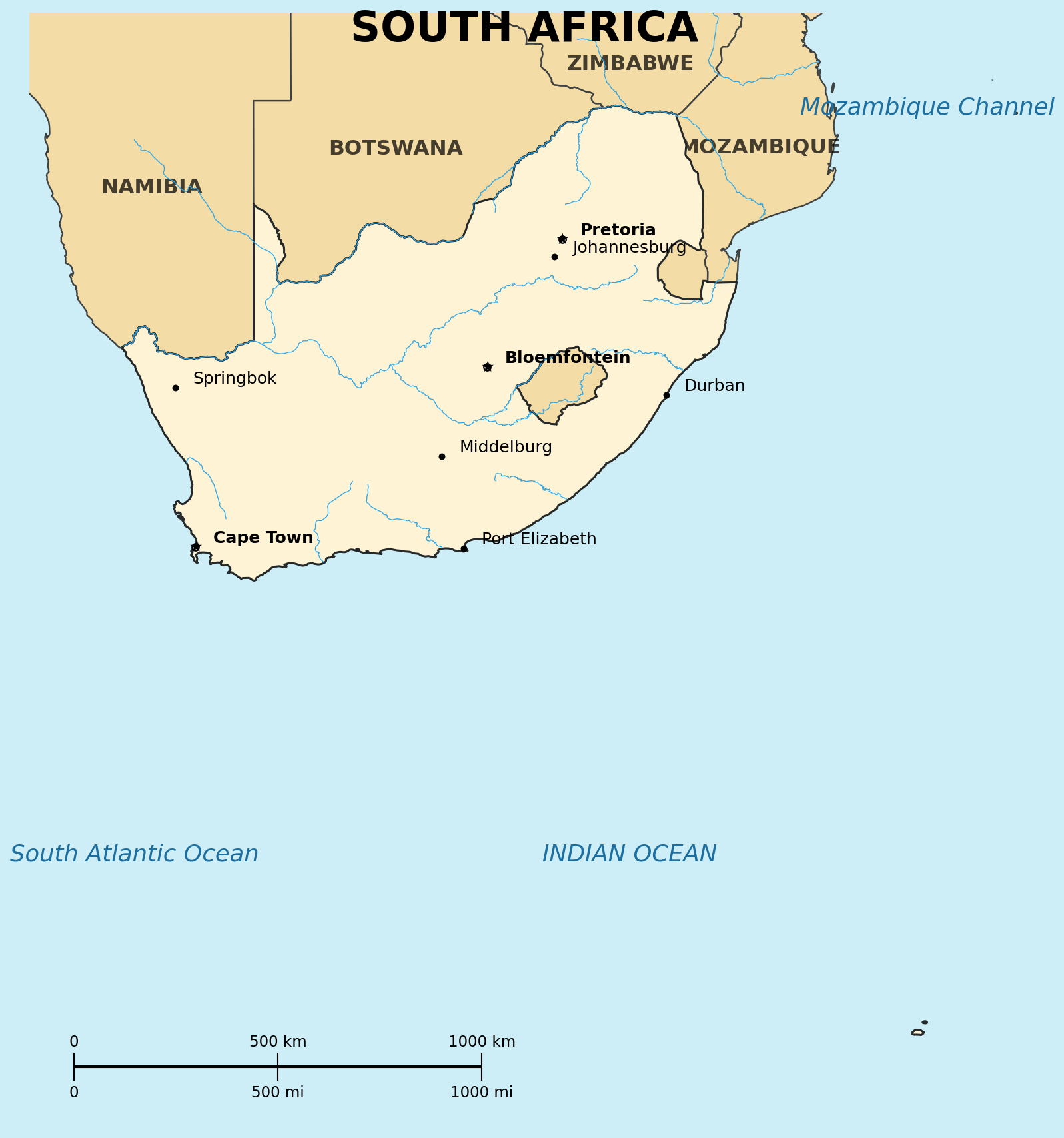
Location: Southern Africa, at the southern tip of the African continent, bordering the South Atlantic Ocean and South Indian Ocean, between Namibia and Mozambique; entirely surrounds Lesotho
Map references: Africa
Land boundaries:
border countries: Botswana, Eswatini, Lesotho (entirely surrounded), Mozambique, Namibia, Zimbabwe
| People |
Population: 63-64 million (2025-2026 est.)
Age structure:
0-14 years: 27.2%
15-64 years: 65.3%
65 years and over: 7.5% (2024 est.)
Median age: 30.7 years (2025 est.)
Nationality:
noun/adjective: South African(s)
Religions: Christian 86%, ancestral/tribal/animist or other traditional African religions 5.4%, Muslim 1.9%, other 1.5%, nothing in particular 5.2% (2015 est.)
Languages: IsiZulu (official) 25.3%, isiXhosa (official) 14.8%, Afrikaans (official) 12.2%, Sepedi (official) 10.1%, Setswana (official) 9.1%, English (official) 8.1%, Sesotho (official) 7.9%, Xitsonga (official) 3.6%, siSwati (official) 2.8%, Tshivenda (official) 2.5%, isiNdebele (official) 1.6%, other 2% (South African Sign Language official; also Khoi/Khoisan/Khoe languages) (2018 est.)
Literacy: total population 91.2% (male 91.5%, female 90.8%) (2024 est.)
Population distribution: concentrated along the southern and southeastern coast, and inland around Pretoria; the eastern half of the country is more densely populated than the west
| Government |
Country name:
conventional long form: Republic of South Africa
conventional short form: South Africa; nicknamed the "Rainbow Nation" for its cultural diversity
Data code: SF
Government type: parliamentary republic
National capital: Pretoria (administrative), Cape Town (legislative), Bloemfontein (judicial) - one of the few countries with three capital cities
Background: South Africa's transition to democracy in the mid-1990s ended decades of apartheid rule; South Africa is a BRICS member since 2010 and made history in 2025 as the first African nation to preside over the G20; four Nobel Peace Prize laureates - Albert Luthuli, Desmond Tutu, Nelson Mandela, and F.W. de Klerk - are associated with the country
| Economy |
Economy - overview: upper-middle-income, newly industrialized economy; Africa's second-largest economy after Nigeria; one of the most mineral-rich countries on Earth, the world's largest producer of platinum group metals, gold, and chromium; strong automobile manufacturing, metalworking, technology, and IT sectors; faces significant infrastructure gaps, elevated crime, and persistently high unemployment
GDP (purchasing power parity): $1.07 trillion (2026 est.)
GDP - real growth rate: 1.3-1.4% (2025-2026)
GDP - per capita: $16,744 PPP (2026 est.)
Inflation rate: 3.1-3.2% (2025-2026)
Unemployment rate: 31.9-33.2% (2024-2025); among the highest in the world
Population below poverty line: 21.46% on less than $2.15/day (2025 est.); close to 60% below the upper-middle-income poverty line
Industries: mining (platinum group metals, gold, chromium), automobile manufacturing, metalworking, technology, machinery, textiles, iron and steel, IT, chemicals, fertilizer, foodstuffs, commercial ship repair
Currency: South African rand (ZAR)
| Transnational Issues |
Trafficking in persons - tier rating: Tier 2 Watch List (2025)