
Country information
Switzerland
- Capital
- Bern
- Population
- 9,124,288
Languages spoken
About Switzerland
German (Swiss German) - the official language, spoken by ~62.1% of the population.
French - also official, spoken by ~22.8%.
Italian - also official, spoken by ~8%.
Romansh - the fourth official language, spoken by less than 1% of the population, mainly in the canton of Graubunden.
German, French, Italian, and Romansh are all national and official languages of Switzerland.
| Geography |
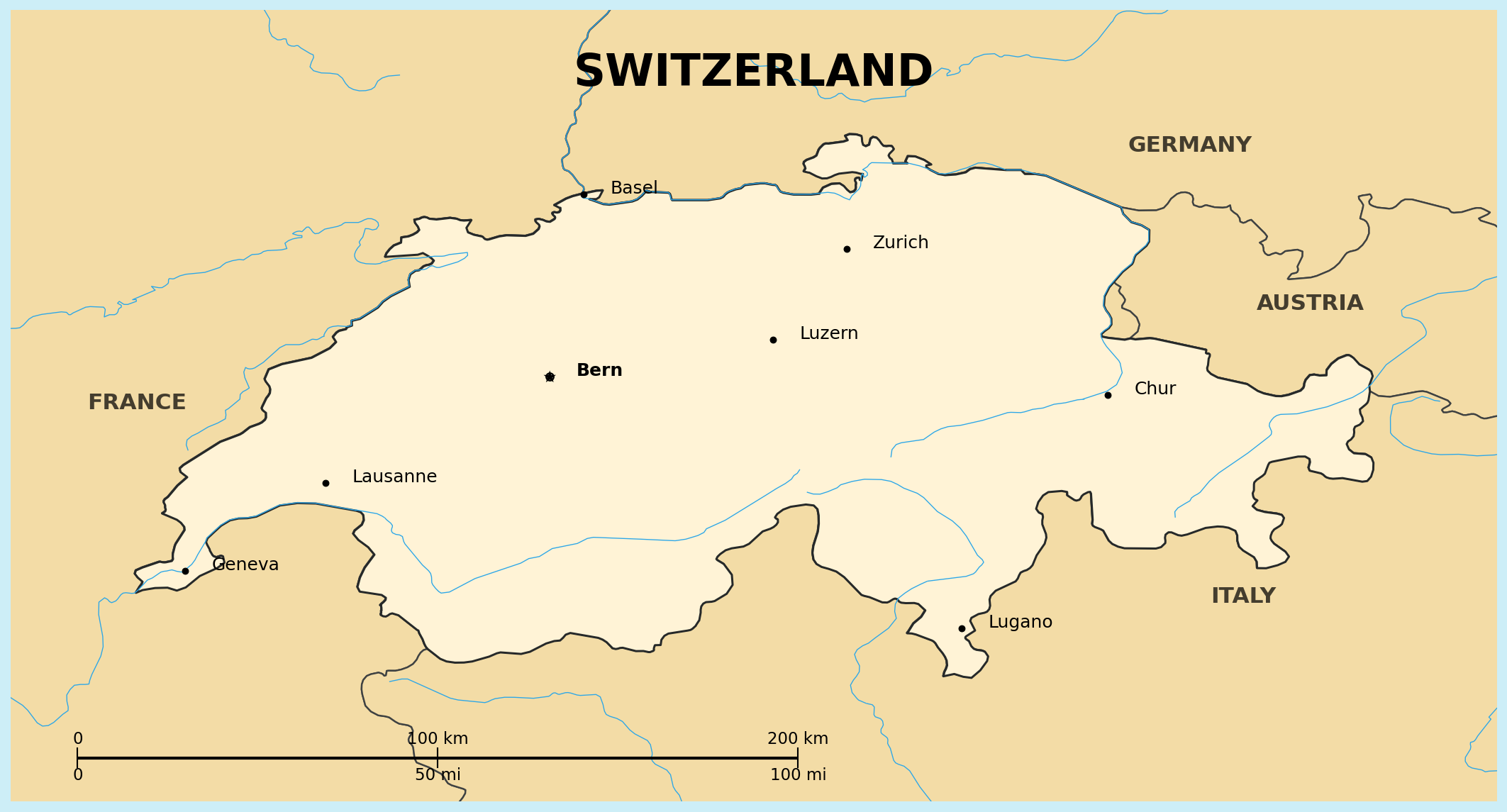
Location: Central Europe, landlocked, bordering France, Germany, Austria, Liechtenstein, and Italy
Map references: Europe
Area:
total: 41,277 sq km
Land boundaries:
border countries: Austria, France, Germany, Italy, Liechtenstein
Terrain: divided into three distinct regions - the Jura Mountains in the northwest, the Alps to the south and east, and the Mittelland (central plateau) between the two mountain ranges
| People |
Population: 8,925,741-8,981,565 (2024-2025 est.)
Age structure:
0-14 years: 15.23%
15-64 years: 66.43%
65 years and over: 18.34%
Life expectancy at birth:
total population: 83.8 years
male: 81.9 years
female: 85.6 years
Infant mortality rate: 3 deaths/1,000 live births (2025 est.)
Nationality:
noun/adjective: Swiss
Ethnic groups: Swiss 69.2%, German 4.2%, Italian 3.2%, Portuguese 2.5%, French 2.1%, Kosovan 1.1%, Turkish 1%, other 16.7% (2020 est.; by country of birth)
Languages: German/Swiss German (official) 62.1%, French (official) 22.8%, Italian (official) 8%, English 5.7%, Portuguese 3.5%, Albanian 3.3%, Romansh (official) 0.5%, other 7.9% (2019 est.)
Population distribution: more than 75% of the population live in the Mittelland/lowlands region; most citizens live in towns and cities, the most populous being Zurich
| Government |
Country name:
conventional long form: Swiss Confederation
conventional short form: Switzerland
Data code: SZ
Government type: federal republic (formally a confederation) of 26 cantons
National capital: Bern
Background: the Swiss Confederation was founded in 1291 as a defensive alliance among three cantons; secured independence from the Holy Roman Empire in 1499; a constitution of 1848 (modified in 1874) replaced the confederation with a centralized federal government; major European powers have long honored Switzerland's sovereignty and neutrality, and the country was not involved in either World War; did not officially join the UN until 2002, though Geneva has long hosted international organizations including the Red Cross
| Economy |
Economy - overview: advanced, high-income economy; among the highest GDP per capita in the world; powered by low corporate tax rates, a highly developed financial services sector, and a high-tech manufacturing industry; not an EU member but holds membership in the IMF, WTO, and World Bank
GDP (purchasing power parity): $881.08 billion (2025 est.)
GDP - real growth rate: 1.3% (2026f)
GDP - per capita: $97,580 PPP (2025 est.); among the highest in the world
Inflation rate: 0.6% (2026)
Currency: Swiss franc (CHF)
| Military |
Military branches: Swiss Armed Forces (Swiss Army): Land Forces, Swiss Air Force (2025)
Military - note: Switzerland has long maintained a policy of military neutrality but periodically participates in EU, NATO, OSCE, and UN peacekeeping operations; Swiss units only participate under UN or OSCE mandate; joined NATO's Partnership for Peace program in 1996 and has contributed to the NATO-led force in Kosovo (KFOR) since 1999 (2025)