

About Benin
French - the sole official language, used in government, education, and business.
Fon - the most widely spoken indigenous vernacular in the south, part of the Gbe language family.
Yoruba - also widely spoken in the south.
Yom, and about half a dozen other regionally important indigenous languages, are spoken in the north.
French is the sole official language of Benin, though most of the population's first language is an indigenous one.
| Geography |
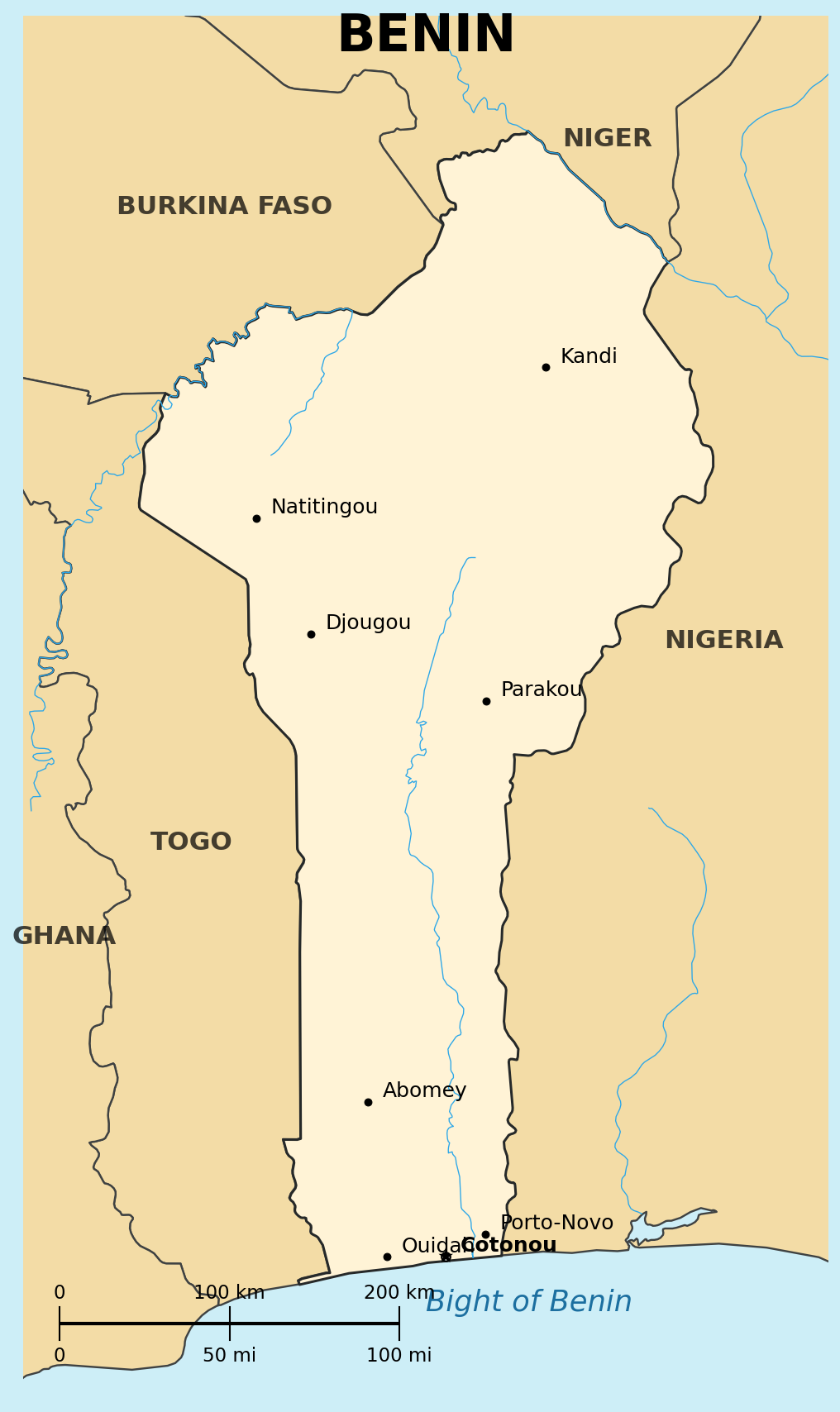
Location: Western Africa, bordering the Bight of Benin, between Nigeria and Togo
Map references: Africa
Area:
total: 114,763 sq km
Land boundaries:
border countries: Burkina Faso, Niger, Nigeria, Togo
Coastline: 121 km; sandbanks create difficult access to a coast with no natural harbors, river mouths, or islands
Climate: tropical; hot, humid in south; semiarid in north
Terrain: mostly flat to undulating plain; some hills and low mountains
Natural resources: small offshore oil deposits, limestone, marble, timber
Natural hazards: hot, dry, dusty harmattan wind may affect north from December to March
| People |
Population: 15,186,090 (2025 est.)
Population distribution: primarily located in the south, with the highest concentration around cities on the Atlantic coast; most of the north remains sparsely populated
Nationality:
noun/adjective: Beninese
Ethnic groups: Fon and related 38.4%, Adja and related 15.1%, Yoruba and related 12%, Bariba and related 9.6%, Fulani and related 8.6%, Ottamari and related 6.1%, Yoa-Lokpa and related 4.3%, Dendi and related 2.9%, other 0.9%, foreigner 1.9% (2013 est.)
Religions: Muslim 27.7%, Roman Catholic 25.5%, Protestant 13.5%, Vodoun 11.6%, other Christian 9.5%, other traditional religions 2.6%, other 2.6%; Vodoun (voodoo) originated in Benin and is openly practiced alongside Christianity and Islam
Languages: 55 languages; French (official); Fon (a Gbe language), Yom (a Gur language), and Yoruba are the most important indigenous languages
Literacy:
total population: 51.4%
male: 62.6%
female: 41.5% (2022 est.)
| Government |
Country name:
conventional long form: Republic of Benin
conventional short form: Benin
former: Dahomey
Data code: BN
Government type: presidential republic
National capital: Porto-Novo (constitutional capital); Cotonou (seat of government)
Independence: 1 August 1960 (from France)
Background: French Dahomey achieved independence in 1960 and changed its name to the Republic of Benin in 1975; a succession of military governments ended in 1972 with the rise of Mathieu KEREKOU's Marxist-Leninist government; a transition to multiparty democracy began in 1989-1990, though recent elections have narrowed political space
| Economy |
Economy - overview: robust economic growth in recent years; slightly declining but still widespread poverty; strong trade relations with Nigeria; cotton is the flagship export; the Port of Cotonou serves as a regional gateway for landlocked Niger
GDP (purchasing power parity): $68.910-76.510 billion (2025-2026 est.)
GDP - real growth rate: 6.7-7.5% (2024-2025 est.)
GDP - per capita: $4,740-4,980 PPP (2025-2026 est.)
Inflation rate: 1.0-1.2% (2024 est.)
Unemployment rate: 1-1.6% (2025 est.)
Labor force: 4,862,455 (2019)
Population below poverty line: 36.2% (2011 est.)
Currency: West African CFA franc (XOF)
| Military |
Military branches: Beninese Armed Forces (FAB); responsible for external defense and internal security; since 2022, has increased troop deployments to the north to counter infiltration by terrorist groups tied to al-Qa'ida and ISIS operating from Burkina Faso and Niger