
Country information
Angola
- Capital
- Luanda
- Population
- 38,778,554
Languages spoken
About Angola
Portuguese - the official language, spoken by ~71.2% of the population.
Umbundu (~23%), Kikongo (~8.2%), Kimbundu (~7.8%), Chokwe (~6.5%), and other Bantu languages are also widely spoken (percentages sum to over 100% as many respondents speak more than one language).
Portuguese is the sole official language of Angola.
| Geography |
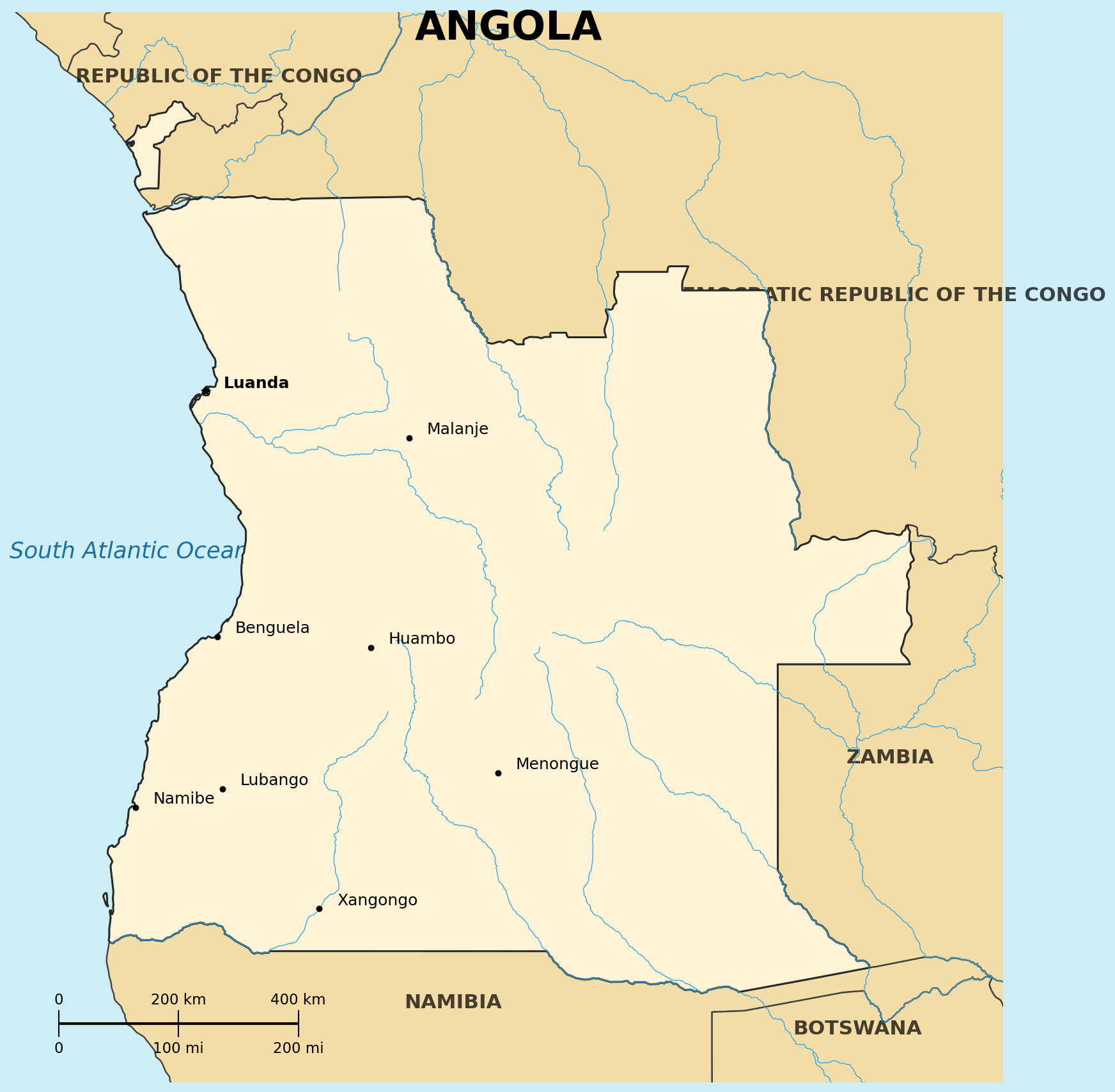
Location: Southern Africa, bordering the South Atlantic Ocean, between Namibia and Republic of the Congo
Map references: Africa
Area:
total: 1,246,700 sq km
Land boundaries:
border countries: Republic of the Congo, Democratic Republic of the Congo, Namibia, Zambia
| People |
Population: 36,604,681-38,984,796 (2024-2025 est.)
Life expectancy at birth: total population 64.6 years (World Bank, 2025)
Nationality:
noun/adjective: Angolan(s)
Ethnic groups: Ovimbundu 37%, Kimbundu 25%, Bakongo 13%, mestico (mixed European and native African) 2%, European 1%, other 22%
Religions: Roman Catholic 41.1%, Protestant 38.1%, other 8.6%, none 12.3% (2014 est.)
Languages: Portuguese (official) 71.2%, Umbundu 23%, Kikongo 8.2%, Kimbundu 7.8%, Chokwe 6.5%, Nhaneca 3.4%, Nganguela 3.1%, Fiote 2.4%, Kwanhama 2.3%, other 3.6% (2014 est.)
Literacy: total population 66.2% (male 83.8%, female 51.9%) (2015 est.)
| Government |
Country name:
conventional long form: Republic of Angola
conventional short form: Angola
Data code: AO
Government type: presidential republic
National capital: Luanda
Background: Bantu-speaking peoples settled the area from the 6th century AD; by the 10th century Bantu kingdoms had formed, of which Kongo became the most powerful; Portuguese traders arrived in the 16th century, establishing coastal colonies and making Angola a major hub of the transatlantic slave trade, which is estimated to have cost the region as many as 4 million people; more than a decade after the end of Angola's 27-year civil war, the country still faces widespread poverty, high maternal/child mortality, and illiteracy despite rapid oil-driven economic growth
| Economy |
Economy - overview: lower-middle-income, least-developed economy heavily dependent on oil production; despite rapid post-war growth, roughly 40% of the population lives below the poverty line
GDP (purchasing power parity): $402.16-417.19 billion (2025-2026 est.)
GDP - real growth rate: 2.1% (2025)
GDP - per capita: $10,230-10,260 PPP (2025-2026 est.)
Inflation rate: 28% (2024 est.)
Unemployment rate: 14.1% (2025 est.)
Population below poverty line: 32.3% (2018 est.)
Currency: Angolan kwanza (AOA)
| Military |
Military branches: Angolan Armed Forces (FAA): Army, Navy, Angolan National Air Force; Ministry of Interior: National Police, Border Guard Police (2025)