
About Ethiopia
Amharic - the official national language, spoken by ~29.3% of the population.
Oromo - the largest single language by speakers, ~33.8%, and an official regional working language.
Somali (~6.2%) and Tigrigna/Tigrinya (~5.9%) are also official regional working languages.
With over 80 ethnic groups, Ethiopia has dozens of other languages including Sidamo, Wolaytta, Gurage, Afar, Hadiyya, Gamo, Gedeo, and Kafa.
Amharic is Ethiopia's official national language, while several others hold official status regionally.
| Geography |
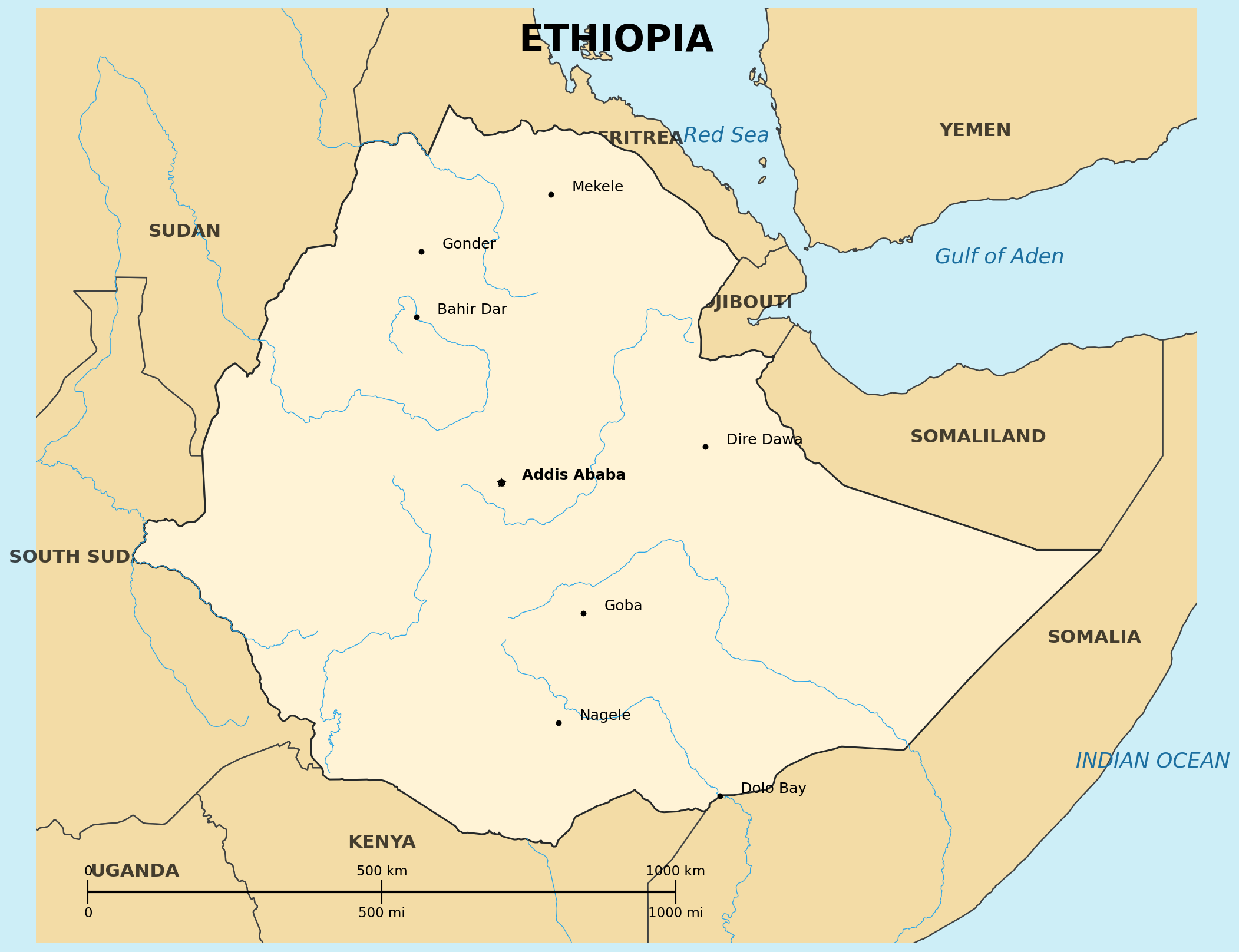
Location: Eastern Africa, west of Somalia, in the Horn of Africa
Map references: Africa
Area:
total: 1,104,300 sq km
Land boundaries:
border countries: Djibouti, Eritrea, Kenya, Somalia, South Sudan, Sudan
Coastline: 0 km (landlocked; most populous landlocked country in the world)
Terrain: high plateau with central mountain range divided by the Great Rift Valley
| People |
Population: 121,372,632 (2025 est.) - 2nd most populous country in Africa
Population distribution: highest density found in the highlands of the north and middle of the country, particularly around the centrally located capital, Addis Ababa; far east and southeast sparsely populated
Nationality:
noun/adjective: Ethiopian(s)
Ethnic groups: more than 80 ethnic groups; Oromo and Amhara are the largest
Religions: Ethiopian Orthodox 43.8%, Muslim 31.3%, Protestant 22.8%, Catholic 0.7%, traditional and other minority faiths
Languages: Oromo (official regional working language) 33.8%, Amharic (official national language) 29.3%, Somali (official regional) 6.2%, Tigrigna (official regional) 5.9%, Sidamo 4%, Wolaytta 2.2%, Gurage 2%, Afar (official regional) 1.7%, Hadiyya 1.7%, Gamo 1.5%, Gedeo 1.3%, other 8.1%, English (2007 est.)
| Government |
Country name:
conventional long form: Federal Democratic Republic of Ethiopia
conventional short form: Ethiopia
Data code: ET
Government type: federal parliamentary republic
National capital: Addis Ababa; seat of the African Union, making Ethiopia Africa's diplomatic capital
Background: rich in cultural and religious diversity with more than 80 ethnic groups; the oldest known hominid fossil comes from Ethiopia; Ethiopia was the second country to officially adopt Christianity, in the 4th century AD; a series of monarchies ruled the region from 980 BC; notably was never colonized; the 2020-2022 Tigray conflict killed hundreds of thousands
| Economy |
Economy - overview: low-income, fast-growing Horn of Africa economy; widespread poverty and food insecurity worsened by conflict and environmental factors; landlocked with tensions over seaport access; coffee (Ethiopia's birthplace), aviation (Ethiopian Airlines is Africa's largest carrier), and the Grand Ethiopian Renaissance Dam's hydropower are key economic drivers; a 2023 debt default pushed the country into debt restructuring and currency reform
GDP (purchasing power parity): $530.83 billion (2026 est.)
GDP - real growth rate: 7.1% (2026f)
GDP - per capita: $4,740 PPP (2026 est.)
Inflation rate: 9.4-21% (2024-2026 est.)
Unemployment rate: 3.3% (2025 est.)
Population below poverty line: 20% (2019)
Currency: Birr (ETB)
| Military |
Military branches: Ethiopian National Defense Force (ENDF): Army, Air Force, Naval Force, Defense Cyber Main Directorate (2025)
Military service age and obligation: 18-22 years of age for voluntary service; 24-month obligation; no compulsory service, though callups can be made and compliance is then compulsory (2025)