Languages spoken in Argentina
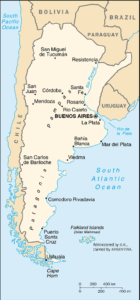
Buenos Aires
46387098
The main languages spoken in Argentina are:
Spanish (Rioplatense Spanish) - the official language, spoken by nearly the entire population.
Italian - a significant minority language due to heavy Italian immigration (up to 62% of Argentines have Italian ancestry).
Indigenous languages including Quechua, Guarani, and Mapudungun are also spoken in various regions.
Smaller communities also speak English, German, French, and Welsh (in Patagonia).
Spanish is the sole official language of Argentina.
| Geography |
Location: Southern South America, bordering the South Atlantic Ocean, between Chile and Uruguay
Map references: South America
Area:
total: 2,780,400 sq km (2nd largest country in South America, 8th largest in the world)
Land boundaries:
border countries: Bolivia, Brazil, Chile, Paraguay, Uruguay
Climate: mostly temperate; arid in southeast; subantarctic in southwest
Terrain: rich plains of the Pampas in the north, flat to rolling plateau of Patagonia in the south, rugged Andes along the western border
Natural resources: fertile plains of the Pampas, lead, zinc, tin, copper, iron ore, manganese, petroleum, uranium
| People |
Population: 45,418,098 (2025 est.)
Age structure:
0-14 years: 23.3%
15-64 years: 63.9%
65 years and over: 12.8% (2024 est.)
Median age: 34.6 years (2025 est.)
Population growth rate: 0.23% (2023 est.)
Life expectancy at birth:
total population: 78.8 years
male: 75.8 years
female: 82.0 years (2024 est.)
Total fertility rate: 1.16 children born/woman (2024)
Nationality:
noun/adjective: Argentine(s)
Religions: Roman Catholic 62.9%, Evangelical 15.3%, Jehovah''s Witness and Church of Jesus Christ 1.4%, other 1.2%, none 18.9% (2019 est.)
Languages: Spanish (official), Italian, English, German, French, indigenous (Quechua, Guarani, Mapudungun)
Population distribution: about one third of the population lives in Buenos Aires
Major urban areas: 15.490 million Buenos Aires (capital), 1.612 million Cordoba, 1.594 million Rosario, 1.226 million Mendoza (2023)
| Government |
Country name:
conventional long form: Argentine Republic
conventional short form: Argentina
local long form: Republica Argentina
Data code: AR
Government type: presidential republic
National capital: Buenos Aires
Independence: 9 July 1816 (from Spain)
| Economy |
Economy - overview: rich natural resources, a highly literate population, an export-oriented agricultural sector, and a diversified industrial base; historically prone to recurring economic crises, high inflation, and external debt; one of the world''s wealthiest countries a century ago
GDP (purchasing power parity): $1.49 trillion (2025 est.)
GDP - real growth rate: 4.4% (2025 est.)
GDP - per capita: $31,310 PPP (2025 est.)
Inflation rate: 31.8% (September 2025)
Unemployment rate: 6.3-7.1% (2025 est.)
Labor force: 21,339,080 (2022)
Population below poverty line: 31.7% (2025)
Industries: food processing and beverages, motor vehicles and auto parts, appliances and electronics, machinery and equipment, chemicals, pharmaceuticals, glass, steel and aluminum, cement, textiles, tobacco products, publishing, furniture, leather
Exports: $87.07 billion (2025)
Currency: Argentine peso (ARS)
| Military |
Military branches: Armed Forces of the Argentine Republic (Fuerzas Armadas de la Republica Argentina): Argentine Army (Ejercito Argentino), Navy of the Argentine Republic (Armada Republica, includes naval aviation), Argentine Air Force (2025)