
Languages spoken in Cuba
Havana
9748007
The main language spoken in Cuba is:
Spanish - the sole official language, spoken by nearly the entire population.
Cuba is linguistically homogeneous compared to many other Caribbean nations, with no significant minority language populations.
Spanish is the sole official language of Cuba.
| Geography |
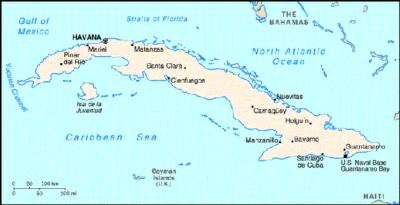
Location: Caribbean, island between the Caribbean Sea and the North Atlantic Ocean, 150 km south of Key West, Florida
Map references: Central America and the Caribbean
Area:
total: 110,860 sq km (largest country in the Caribbean; westernmost island of the Greater Antilles)
Climate: tropical; moderated by trade winds; dry season (November to April); rainy season (May to October)
Natural hazards: the east coast is subject to hurricanes from August to November (averaging about one hurricane every other year); droughts are common
| People |
Population: 10,059,519 (2025 est.)
Population distribution: large population clusters found throughout the country, the more significant ones in larger towns and cities, particularly the capital, Havana
Infant mortality rate: 5.2 deaths/1,000 live births (2025 est.)
Nationality:
noun/adjective: Cuban(s)
Ethnic groups: White 64.1%, Mulatto or mixed 26.6%, Black 9.3% (2012 census; racial self-identification)
Languages: Spanish (official)
Literacy: total population 94.7% (2022 est.)
| Government |
Country name:
conventional long form: Republic of Cuba
conventional short form: Cuba
Data code: CU
Government type: communist state
National capital: Havana
Independence: 20 May 1902 (from Spain, 10 December 1898; administered by the US from 1898 to 1902)
Background: the native Amerindian population declined after Spanish colonization beginning 1492; the island became an independent republic in 1902 after US military rule following the Spanish-American War; a 1959 revolution led by Fidel CASTRO established a communist government that has remained in power for over six decades
| Economy |
Economy - overview: still largely a state-run planned economy, though privatization is increasing under the new constitution; a known tobacco exporter; economy constrained by aging infrastructure and long-standing US sanctions; the country has experienced severe fuel shortages, widespread protests over shortages of basic necessities and electricity, and widespread corruption; Cuba depends heavily on imported oil, historically from Venezuela and Mexico, and has faced significant disruptions to those supplies
GDP (nominal): $107.35 billion (2020)
GDP - per capita: $9,605 (2020)
Unemployment rate: 1.6% (2024, official rate; unofficial estimates are considerably higher)
Labor force: 5,088,527 (2019); state sector 72.3%, non-state sector 27.7%
Industries: petroleum, nickel, cobalt, pharmaceuticals, tobacco, construction, steel, cement, agricultural machinery, sugar
Agriculture - products: sugarcane, cassava, plantains, vegetables, mangoes/guavas, milk, tomatoes, bananas
Currency: Cuban peso (CUP)
| Communications |
Broadcast media: government owns and controls all broadcast media: 8 national TV channels, 2 international channels, multiple regional TV stations, 7 national radio networks, plus regional radio stations
| Military |
Military - note: the Cuban military is largely focused on protecting territorial integrity and the state, viewing the US as its primary threat; it is a central pillar of the regime, holds a large role in politics and the economy, and reportedly has commercial interests across agriculture, banking, construction, tourism, and other sectors (2025)
Military service age and obligation: mandatory for men, voluntary for women (ages 17-28); 24-month service obligation; reserve commitment for men until age 45 (2025)
| Transnational Issues |
Trafficking in persons - tier rating: Tier 3 (2025) - Cuba does not fully meet the minimum standards for the elimination of trafficking and is not making significant efforts to do so