Languages spoken in Denmark
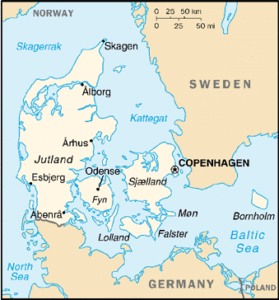
Copenhagen
6031247
The main languages spoken in Denmark are:
Danish - the official language, spoken by the vast majority of the population.
Faroese and Greenlandic (an Inuit dialect) - also official languages, reflecting the Kingdom of Denmark''s inclusion of the Faroe Islands and Greenland.
German - spoken by a small minority near the German border.
English is the predominant second language taught and spoken nationwide.
Danish, Faroese, and Greenlandic are the official languages of the Kingdom of Denmark.
| Geography |
Location: Northern Europe, bordering the Baltic Sea and the North Sea, on a peninsula north of Germany (Jutland); includes several major islands
Map references: Europe
Area:
total: 43,094 sq km (mainland Denmark; the Kingdom of Denmark also includes self-governing Greenland and the Faroe Islands)
Environment - current issues: air pollution, principally from vehicle and power-plant emissions; nitrogen and phosphorus pollution of the North Sea; water pollution from animal wastes and pesticides
| People |
Population: 6,051,491 (2025 est.)
Age structure:
0-14 years: 16.42%
65 years and over: 19.91%
Life expectancy at birth:
total population: 81.66 years
male: 79.74 years
female: 83.71 years
Infant mortality rate: 3.04 deaths/1,000 live births
Nationality:
noun/adjective: Dane(s)/Danish
Ethnic groups: Danish (includes Greenlandic, predominantly Inuit, and Faroese) 84.2%, Turkish 1.1%, other 14.7% (largest groups Polish, Romanian, Syrian, Ukrainian, German, Iraqi) (2023 est.; by country of origin)
Religions: Evangelical Lutheran (official) 71.4%, Muslim 4.3%, other/none/unspecified 24.3% (2024 est.)
Languages: Danish, Faroese, Greenlandic (an Inuit dialect), German (small minority); English is the predominant second language
Population distribution: population centers tend to be along coastal areas, particularly in Copenhagen and the eastern side of the mainland
| Government |
Country name:
conventional short form: Denmark
Data code: DA
Government type: unitary parliamentary constitutional monarchy
National capital: Copenhagen
Independence: declared national day 5 June 1849 (adoption of constitution)
Background: the Kingdom of Denmark comprises Denmark, Greenland, and the Faroe Islands; the absolute monarchy ended with the signing of a constitution in June 1849
| Economy |
Economy - overview: thoroughly modern market economy featuring advanced industry with world-leading firms in pharmaceuticals (Novo Nordisk), maritime shipping (Maersk), and renewable energy (Vestas), plus a high-tech agricultural sector; extensive government welfare measures; krone pegged to the euro
GDP (purchasing power parity): $544.05 billion (2026 est.)
GDP - real growth rate: 2.5% (2023)
GDP - per capita: $88,791 PPP (2025 est.)
Inflation rate: 2.0% (2025)
Unemployment rate: 5.5% (2025 est.)
Population below poverty line: 4% (2021)
Currency: Danish krone (DKK)
| Military |
Military branches: Danish Armed Forces (Forsvaret): Royal Danish Army, Royal Danish Navy, Royal Danish Air Force (2025)
Military service age and obligation: 18 years of age for compulsory and voluntary service, men and women; draftees serve 11 months (5 months basic training, 6 months operational) (2025)
Military - note: Denmark contributes air, ground, and naval forces to international missions, including NATO''s forward defenses in Latvia (2025)