
Languages spoken in Kiribati (Republic of)
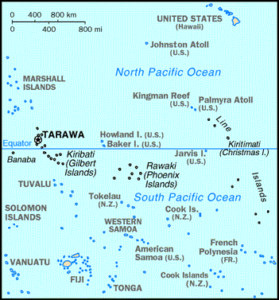
Tarawa
120740
The main languages spoken in Kiribati are:
English - an official language, used in government and formal education.
Gilbertese (I-Kiribati) - also official, a Micronesian language spoken by nearly the entire population in daily life.
Both English and Gilbertese are official languages of Kiribati.
| Geography |
Location: Oceania, a group of 33 atolls and coral islands in the central Pacific Ocean, straddling the equator; roughly halfway between Hawaii and Australia
Map references: Oceania
Area:
total: 811 sq km, spread over an area roughly the size of India
Geography - note: consists of three archipelagos: the Gilbert Islands, Line Islands, and Phoenix Islands; the eastern Line Islands and central Phoenix Islands are sparsely populated, while the western Gilbert Islands (especially South Tarawa) are among the most densely settled places on Earth; one of the first places on Earth to welcome each new day; particularly vulnerable to climate change and rising sea levels
| People |
Population: 116,545-138,000 (2024-2026 est.)
Age structure:
0-14 years: 26.8%
15-64 years: 67.9%
65 years and over: 5.4% (2024 est.)
Life expectancy at birth: total population 66.5 years (World Bank, 2025)
Nationality:
noun/adjective: I-Kiribati
Ethnic groups: Gilbertese 95.7%, other 4.3% (2020 census)
Religions: Roman Catholic 58.9%, Kiribati Uniting Church 21.2%, Kiribati Protestant Church 8.4%, Church of Jesus Christ 5.6%, Seventh Day Adventist 2.1% (2020 est.)
Languages: English (official), Gilbertese/I-Kiribati (official)
| Government |
Country name:
conventional long form: Republic of Kiribati
conventional short form: Kiribati
Data code: KR
Government type: unitary parliamentary republic with an executive president
National capital: South Tarawa
Independence: 12 July 1979 (from the UK)
Executive branch:
chief of state and head of government: President Taneti Maamau
Background: the first Austronesian voyagers arrived in the Gilbert Islands as early as 3000 BC, though the islands were not widely settled until about 200 AD by Micronesians; around 1300, Samoans and Tongans invaded the southern Gilbert Islands (then known as Tungaru), bringing Polynesian cultural elements
| Economy |
Economy - overview: lower-middle-income, environmentally fragile Pacific island economy; public sector-dominated; sizable remittances, a key phosphate mining trust fund, and tourism/fishing revenue sustain the economy; recent political developments include withdrawal from the Pacific Islands Forum and an ongoing constitutional crisis
GDP (purchasing power parity): $297-308 million (2023-2025 est.)
GDP - real growth rate: 5.3% (2025)
GDP - per capita: $2,289-2,381 (2023-2025 est.)
Inflation rate: 2.5% (2025)
Currency: Australian dollar (AUD)
| Military |
Military - note: Kiribati has no standing military; Australia, New Zealand, and the US have provided security assistance; Kiribati has a "ship rider" agreement with the US allowing local maritime law enforcement officers to embark on US Coast Guard and Navy vessels to enforce laws within its exclusive economic zone (2025)