Languages spoken in Liechtenstein
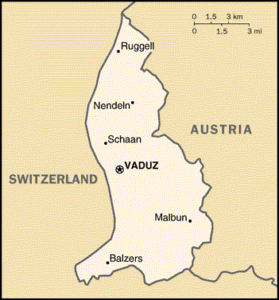
Vaduz
41237
The main language spoken in Liechtenstein is:
German - the sole official language, spoken by ~91.5% of the population; the local Alemannic dialect is the main spoken variant.
Italian, Turkish, and Portuguese are also spoken by smaller immigrant communities.
German is the sole official language of Liechtenstein.
| Geography |
Location: Central Europe, between Austria and Switzerland
Map references: Europe
Area:
total: 160.50 sq km; Europe''s fourth-smallest country
Land boundaries:
border countries: Austria, Switzerland
Climate: continental; cold, cloudy winters with frequent snow or rain; cool to moderately warm, cloudy, humid summers; variety of microclimates based on elevation
Geography - note: along with Uzbekistan, one of only two doubly landlocked countries in the world (landlocked and bordered only by other landlocked countries)
| People |
Population: 40,457-41,237 (2023-2025 est.)
Median age: 44.4 years (2025 est.)
Life expectancy at birth:
total population: 83 years
male: 80.7 years
female: 85.8 years (2024 est.)
Nationality:
noun/adjective: Liechtensteiner(s)
Ethnic groups: Liechtensteiner 65.6%, Swiss 9.6%, Austrian 5.8%, German 4.5%, Italian 3.1%, other 11.4% (2021 est.)
Religions: Roman Catholic (official) 73.4%, Protestant Reformed 6.3%, Muslim 5.9%, Christian Orthodox 1.3%, none 7% (2015 est.)
Languages: German (official, Alemannic main dialect) 91.5%, Italian 1.5%, Turkish 1.3%, Portuguese 1.1%, other 4.6% (2015 est.)
| Government |
Country name:
conventional long form: Principality of Liechtenstein
conventional short form: Liechtenstein; named after the Liechtenstein family, which purchased and united the counties of Schellenberg and Vaduz in 1719
Data code: LS
Government type: parliamentary constitutional monarchy; the prince retains real political power, confirmed by referendum
National capital: Vaduz
Background: established within the Holy Roman Empire in 1719; occupied by French and Russian troops during the Napoleonic Wars; became a sovereign state in 1806 and joined the German Confederation in 1815; became fully independent in 1866 when the Confederation dissolved; remained neutral during World War II
| Economy |
Economy - overview: high-income European microstate economy; astonishingly industrial for its size (Hilti tools, Ivoclar dental ceramics) alongside private banking and asset management; among the world''s highest GDP per capita, with more registered companies than residents; in customs union with Switzerland, uses the Swiss franc, and participates in the Schengen Area; most of its workforce commutes daily from Switzerland, Austria, and Germany
GDP (purchasing power parity): $7.172-8.179 billion (2024-2025 est.)
GDP - real growth rate: 1.0% (2025f)
GDP - per capita: $201,110 PPP (2025 est.) - among the highest in the world
Inflation rate: 2.8% (2022)
Unemployment rate: 1.3% (2022)
Currency: Swiss franc (CHF)
| Military |
Military - note: no regular military forces; National Police of the Principality of Liechtenstein (Landespolizei) handles security (2025)