Languages spoken in Papua New Guinea
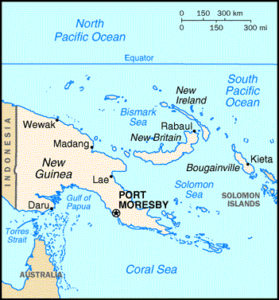
Port Moresby
10185363
The main languages spoken in Papua New Guinea are:
English - one of three official languages.
Tok Pisin - one of three official languages, an English-based creole serving as a major lingua franca.
Hiri Motu - the third official language, historically important in the Papua region.
Papua New Guinea is the world''s most linguistically diverse country, with over 800 distinct indigenous languages spoken among its roughly 10-12 million people.
English, Tok Pisin, and Hiri Motu are the three official languages of Papua New Guinea.
| Geography |
Location: Oceania, occupying the eastern half of the island of New Guinea (the world''s second-largest island) along with over 600 smaller islands, between the Coral Sea and the South Pacific Ocean, east of Indonesia
Map references: Oceania
Area:
total: 462,840 sq km; the world''s third-largest island country
Land boundaries:
border countries: Indonesia
Geography - note: the name derives from the Malay word pua-pua, describing the tightly curled hair of the Papuan people; home to an estimated 5-7% of the world''s tropical rainforest
| People |
Population: 9.6-11.8 million (estimates vary considerably; a 2022 UN satellite-based survey suggested a much higher figure before a 2023 revision settled around 11.8 million; 2022-2025 est.)
Life expectancy at birth: total population 66.1-69.43 years
Infant mortality rate: 33.59 deaths/1,000 live births
Nationality:
noun/adjective: Papua New Guinean(s)
Religions: almost all Papua New Guineans are Christian, predominantly Protestant and Catholic; prayer and church attendance are part of daily life
Languages: English (official), Hiri Motu (official), Tok Pisin (official); over 800 additional indigenous languages, making PNG the world''s most linguistically diverse country
Literacy: total population 70.1% (male 78.4%, female 61.6%) (2017 est.)
Population distribution: the indigenous population is one of the most heterogeneous in the world, with several thousand separate communities, most numbering only a few hundred people, divided by language, customs, and tradition; most of the population lives by subsistence, particularly in the highlands
| Government |
Country name:
conventional long form: Independent State of Papua New Guinea
conventional short form: Papua New Guinea
Data code: PP
Government type: parliamentary constitutional monarchy; a Commonwealth realm
National capital: Port Moresby
Independence: 16 September 1975 (from the Australian-administered UN trusteeship)
| Economy |
Economy - overview: lower-middle-income economy; dominated by two main drivers - agriculture, forestry, and fishing on one hand, and minerals and hydrocarbons extraction (LNG, gold, copper, oil) on the other; extractive-industry wealth remains highly concentrated, and most of the population relies on subsistence agriculture
GDP (purchasing power parity): $48.1-51.56 billion (2024-2025 est.)
GDP - real growth rate: 4.6% (2025)
GDP - per capita: $3,757 PPP (2025 est.)
Inflation rate: 4.4% (2020 est.)
Unemployment rate: 2.6% (2025 est.)
Population below poverty line: 39.9% (2009 est.); 65.6% on less than $3.20/day (2009)
Currency: Papua New Guinean kina (PGK)
| Military |
Military branches: Papua New Guinea Defense Force (PNGDF), tasked with defense of the country and territories against external attack, as well as internal security and socio-economic development duties; primary combat unit is the Royal Pacific Islands Regiment; has bilateral defense cooperation agreements with Australia, Indonesia, the UK, and the US, including a 2023 agreement allowing US military development and operations from PNG bases (2025)
| Transnational Issues |
Trafficking in persons - tier rating: Tier 3 (2025)