Languages spoken in Slovenia
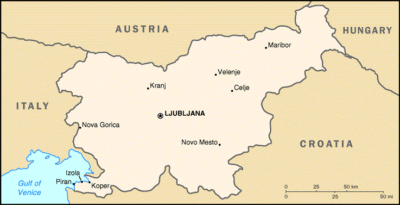
Ljubljana
2135107
The main language spoken in Slovenia is:
Slovene - the sole official language nationally, spoken by ~87.7% of the population; the smallest non-island European state with a single and unique official language.
Croatian, Serbo-Croatian, Bosnian, and Serbian are also spoken by minority communities.
Hungarian and Italian are also official languages, but only in the municipalities where those national minorities reside.
Slovene is the sole official language of Slovenia nationally, with Hungarian and Italian holding regional official status.
| Geography |
Location: Central Europe, bordering the Adriatic Sea, between Austria and Croatia
Map references: Europe
Area:
total: 20,272-20,273 sq km
Land boundaries:
border countries: Austria, Croatia, Hungary, Italy
Natural resources: lignite coal, lead, zinc, building stone, hydropower, forests
| People |
Population: 2.1-2.14 million (2024-2025 est.)
Age structure:
0-14 years: 14.3%
15-64 years: 62.5%
65 years and over: 23.2%
Life expectancy at birth: total population 82.0 years (World Bank, 2025); among the highest in the world
Nationality:
noun/adjective: Slovene(s)
Ethnic groups: Slovene 83.1%, Serb 2%, Croat 1.8%, Bosniak 1.1%, other/unspecified 12% (2002 census)
Religions: Catholic 57.8-69%, Orthodox 2.3-4%, Muslim 2.4-3%, other Christian 0.9-1%, atheist/non-believer 10.1-18%, unaffiliated/unspecified 3.5-25% (varies by source; 2002-2019 est.)
Languages: Slovene (official) 87.7-91.1%, Croatian 2.8%, Serbo-Croatian 1.8-4.5%, Bosnian 1.6%, Serbian 1.6%, Hungarian 0.4% (official in some municipalities), Italian 0.2% (official in some municipalities), other 3.9-4.4% (2002 est.)
| Government |
Country name:
conventional short form: Slovenia
Data code: SI
Government type: parliamentary republic
National capital: Ljubljana
Independence: 25 June 1991 (from Yugoslavia)
Background: the Slovene lands were part of the Austro-Hungarian Empire until its dissolution at the end of WWI; in 1918 Slovenia joined the Serbs and Croats to form a new multinational state, renamed Yugoslavia in 1929; after WWII became a republic of renewed (Communist) Yugoslavia, though the country distanced itself from Moscow''s rule; dissatisfied with the exercise of power by the Serb majority, Slovenes established independence in 1991 after a short 10-day war; joined NATO and the EU in 2004, and the eurozone in 2007
| Economy |
Economy - overview: advanced, high-income EU and Eurozone economy; the most prosperous of the former Yugoslav states, transitioning almost seamlessly to EU and eurozone membership; among Europe''s most egalitarian societies by income distribution; pharmaceuticals, household appliances, and the Port of Koper (a key Central European gateway) drive an export economy tightly linked to Germany
GDP (purchasing power parity): $113-129.498 billion (2024-2026 est.)
GDP - real growth rate: 1.5-2.6% (2024-2025)
GDP - per capita: $58,150-60,663 PPP (2025-2026 est.)
Inflation rate: 2.0% (2025)
Unemployment rate: 3.2-4.5% (varies by source; 2021-2025)
Population below poverty line: 12.7% at risk of poverty (2025)
Industries: ferrous metallurgy and aluminum products, lead and zinc smelting, electronics, trucks, automobiles, electric power equipment, wood products, textiles, chemicals, pharmaceuticals, machine tools
Currency: Euro (EUR)
| Military |
Military branches: Slovenian Armed Forces (Slovenska Vojska, SV): combined force with air, land, maritime, and special operations components; Ministry of Interior: National Police (2025)
Military manpower: approximately 6,000 active military personnel (2025)