

About Niger
Hausa - the most widely spoken, ~53.1% of the population.
French - the official language, though a first language for only a small minority.
Zarma/Songhai (~21.2%), Tuareg (~11%), Fulfulde/Peuhl (~6.5%), and Kanuri (~5.9%) are also widely spoken.
Niger has 10 recognized national languages: Arabic, Buduma, Fulfulde, Gurmancema, Hausa, Kanuri, Sonay-Zarma, Tamajaq, Tassawaq, and Tubu.
French is the sole official language of Niger.
| Geography |
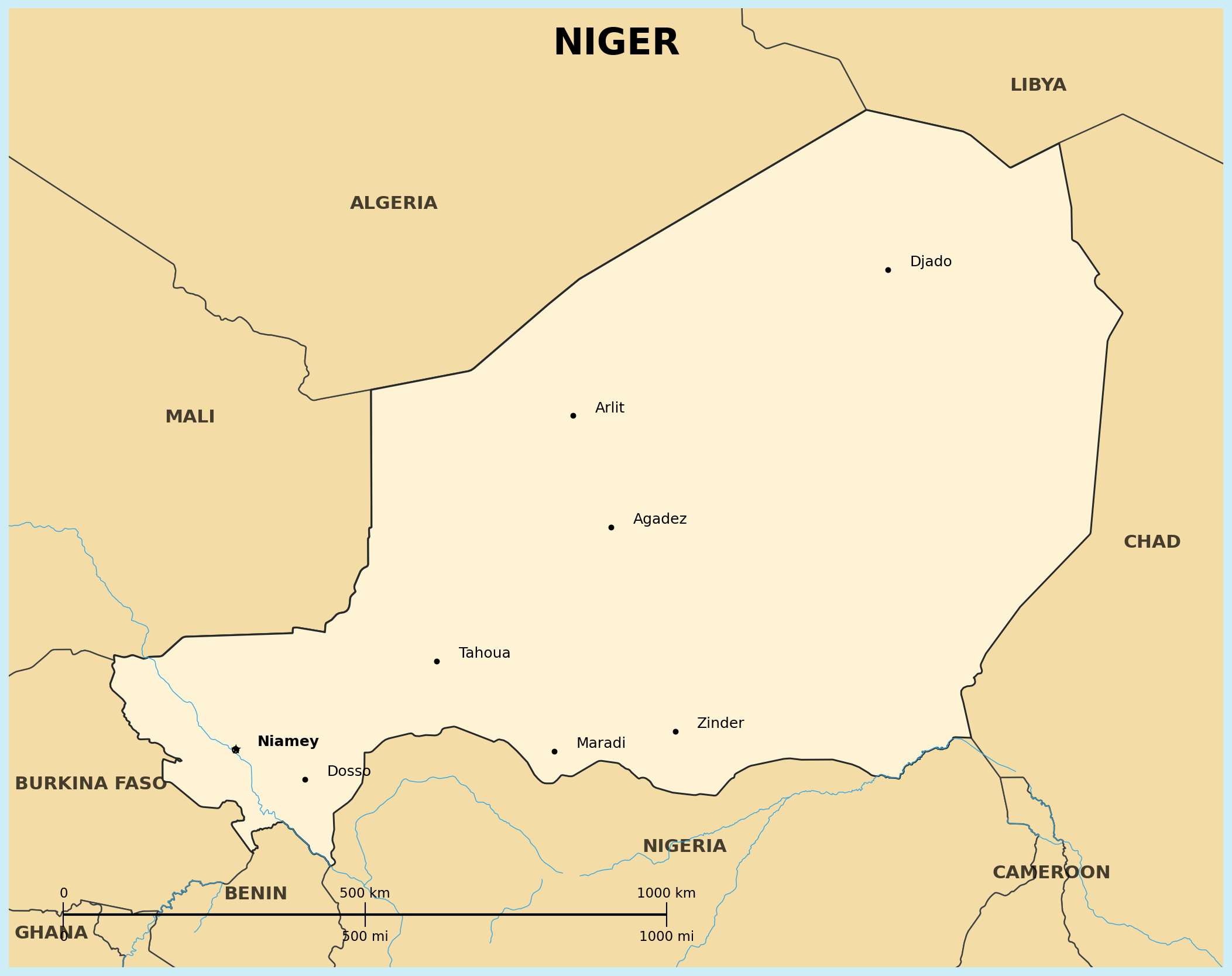
Location: Western Africa, southeast of Algeria; landlocked
Map references: Africa
Area:
total: 1,267,000 sq km; one of the largest countries in Africa by land area
Land boundaries:
border countries: Algeria, Benin, Burkina Faso, Chad, Libya, Mali, Nigeria (7 countries)
Terrain: one of the hottest countries in the world; northern four-fifths is desert, southern one-fifth is savanna suitable for livestock and limited agriculture
| People |
Population: 26.3-27.3 million (2024-2025 est.); one of the highest total fertility rates in the world at approximately 6-7.6 children per woman
Age structure:
0-14 years: 50.58%
65 years and over: 2.68% (2022 est.)
Life expectancy at birth: 60.09 years (male 58.55, female 61.68)
Infant mortality rate: 66.81 deaths/1,000 live births
Nationality:
adjective: Nigerien
Ethnic groups: Hausa 53.1%, Zarma/Songhai 21.2%, Tuareg 11%, Fulani (Peuhl) 6.5%, Kanuri 5.9%, Gurma 0.8%, Arab 0.4%, Tubu 0.4%, other 0.9% (2006 est.)
Languages: Hausa, Zarma, French (official), Fufulde, Tamashek, Kanuri, Gurmancema, Tagdal (most-spoken languages); 10 national languages total: Arabic, Buduma, Fulfulde, Gurmancema, Hausa, Kanuri, Sonay-Zarma, Tamajaq, Tassawaq, Tubu
Literacy: total population 35.6% (male 47.9%, female 25.7%) (2022 est.)
Population distribution: majority located in the southernmost extreme of the country, along the border with Nigeria and Benin
| Government |
Country name:
conventional long form: Republic of Niger
conventional short form: Niger; named for the Niger River, from the local Tuareg name egereou n-igereouen ("big rivers")
Data code: NG
Government type: transitional military government
National capital: Niamey
Executive branch: Abdourahamane Tchiani, president of the National Council for the Safeguarding of the Country (transitional military council)
Background: the military has played a role in Niger's domestic politics since 1960-61; a military junta led by General Abdourahamane Tiani seized power in a coup on 26 July 2023, detaining democratically elected President Bazoum and dissolving government institutions; a Charter of the Refoundation, providing for a five-year transition plan, was promulgated on 26 March 2025, with Tchiani sworn in as transitional president; ISIS-Greater Sahara and al-Qaida affiliate JNIM are active in western Niger, with Nigeria-based Boko Haram and ISIS-West Africa threatening the southeast; Niger formed the Alliance of Sahel States with Mali and Burkina Faso in 2023
| Economy |
Economy - overview: low-income, least-developed West African economy; heavily dependent on agriculture, which employs about 87% of the labor force; uranium mining is a key export sector; economic development strained by extreme poverty, political instability, and security threats
GDP (purchasing power parity): $61.04 billion (2025f)
GDP - real growth rate: 6.6% (2025f)
GDP - per capita: $2,100 PPP (2025 est.)
Inflation rate: 7.829% (2024)
Unemployment rate: 0.55-7.5% (varies by source; 2023-2025)
Population below poverty line: 44.5% (2014)
Industries: uranium mining, petroleum, cement, brick, soap, textiles, food processing, chemicals, slaughterhouses
Currency: West African CFA franc (XOF)
| Transnational Issues |
Trafficking in persons - tier rating: Tier 2 Watch List (2025)