
Country information
Namibia
- Capital
- Windhoek
- Population
- 3,022,401
Languages spoken
About Namibia
Oshiwambo languages - spoken by ~49.7% of the population, the largest language group.
English - the sole official language, spoken by only ~2.3% as a first language.
Nama/Damara (~11%), Kavango languages (~10.4%), Afrikaans (~9.4%, a common second language for much of the population), and Herero languages (~9.2%) are also widely spoken.
Namibia has 13 recognized national languages in total, including 10 indigenous African languages and 3 Indo-European languages.
English is the sole official language of Namibia.
| Geography |
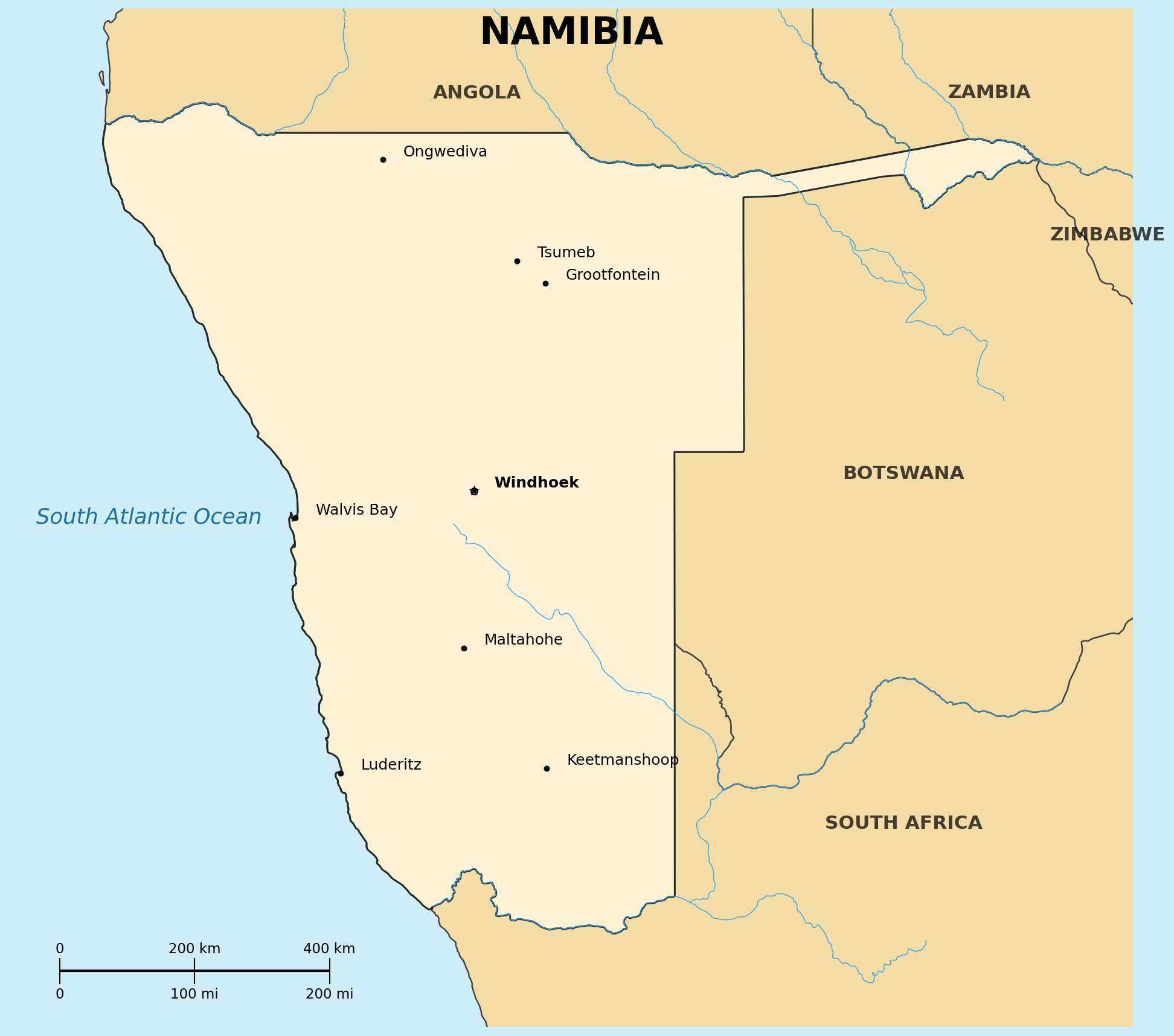
Location: Southern Africa, bordering the South Atlantic Ocean, between Angola and South Africa
Map references: Africa
Area:
total: 824,292 sq km
Land boundaries:
border countries: Angola, Botswana, South Africa, Zambia
Geography - note: the Namib Desert, after which the country is named, is considered the oldest desert in the world; some 14% of the land is protected, including virtually the entire Namib Desert coastal strip; the name "namib" comes from the local Nama language, meaning "an area where there is nothing"
| People |
Population: 2.85-3.02 million (2023-2025 est.); very low population density
Life expectancy: Namibia's fertility rate has fallen from about 4.5 children per woman in 1996 to 3 in 2022, due to increasing urbanization and family planning access
Nationality:
noun/adjective: Namibian(s)
Ethnic groups: Ovambo 50%, Kavangos 9%, Herero 7%, Damara 7%, mixed European and African ancestry 6.5%, European 6%, Nama 5%, Caprivian 4%, San 3%, Baster 2%, Tswana 0.5%
Religions: Christian 97.5%, other (Muslim, Baha'i, Jewish, Buddhist) 0.6%, unaffiliated 1.9% (2020 est.)
Languages: Oshiwambo languages 49.7%, Nama/Damara 11%, Kavango languages 10.4%, Afrikaans 9.4%, Herero languages 9.2%, Zambezi languages 4.9%, English (official) 2.3%, other 3.2% (2016 est.); 13 recognized national languages total
Literacy: total population 87.6% (male 87.9%, female 87.4%) (2023 est.)
Population distribution: very low density overall, with the largest clusters in the extreme north-central area along the border with Angola
| Government |
Country name:
conventional long form: Republic of Namibia
conventional short form: Namibia
Data code: WA
Government type: presidential republic
National capital: Windhoek
Background: various ethnic groups occupied southwestern Africa prior to Germany establishing a colony over most of the territory in 1884; South Africa occupied the colony (then German South West Africa) in 1915 during WWI and administered it as a mandate until annexing it after WWII; Namibia gained independence from South Africa in 1990
| Economy |
Economy - overview: lower-middle-income, developing economy; mining accounts for nearly 30% of GDP, with diamonds, uranium, gold, and base metals as key exports; financial services, trade, manufacturing, agriculture, and fishing also significant; gold and natural gas becoming increasingly important
GDP (purchasing power parity): $37.63 billion (2025 est.)
GDP - real growth rate: 3.8% (2025)
GDP - per capita: $12,341 PPP (2025 est.)
Inflation rate: 3.5% (2025)
Unemployment rate: 36.9% (strict), 54.8% (broad definition) (2023)
Industries: financial services, wholesale and retail trade, manufacturing (beverages, grain mill products, meat/fish processing, dairy, diamond processing), mining (diamonds, gold, uranium, copper, lead, zinc, tin, silver, tungsten), agriculture, fishing
Currency: Namibian dollar (NAD), pegged 1:1 to the South African rand
| Military |
Military - note: Namibian Defense Force's (NDF) inventory consists mostly of Soviet-era weapons; over the past decade has received a limited number of newer systems from China and South Africa; Namibia has a small defense industry producing items such as armored personnel carriers (2025)