Languages spoken in Uganda
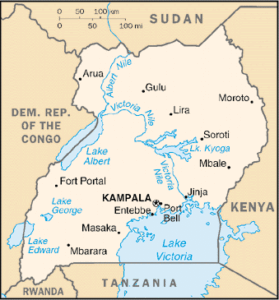
Kampala
45905417
The main languages spoken in Uganda are:
English - the official language, taught in schools, used in courts of law and by most newspapers and some radio broadcasts.
Swahili - also official, increasingly used in East African regional contexts.
Ganda (Luganda) - the most widely used of the Niger-Congo languages, and the language used most often in the capital, Kampala.
Numerous other Niger-Congo and Nilo-Saharan languages are also spoken, along with Arabic.
English and Swahili are both official languages of Uganda.
| Geography |
Location: Eastern Africa, landlocked, west of Kenya
Map references: Africa
Area:
total: 241,038 sq km
Land boundaries:
border countries: Democratic Republic of the Congo, Kenya, Rwanda, South Sudan, Tanzania
| People |
Population: 45.9-50.9 million (varies by source; 2024-2025 est.); one of the youngest and most rapidly growing populations in the world
Age structure:
0-14 years: 48.21%
65 years and over: 2.38% (2024 census)
Life expectancy at birth: total population 68.96 years (male 66.71, female 71.27)
Infant mortality rate: 30.45 deaths/1,000 live births
Nationality:
noun/adjective: Ugandan(s)
Ethnic groups: Baganda 15.3%, Banyankole 9.1%, Basoga 8.1%, Bakiga 6.4%, Iteso 6.8%, Langi 5.9%, Bagisu 4.5%, Acholi 4.2%, Lugbara 2.6%, other 37.1% (2024 census)
Religions: Christian 81.7% (Roman Catholic 42%, Protestant 29%), Islam 13.2%, unclassified 3.3%, other 1.6% (2024 census)
Languages: English (official), Ganda/Luganda (most widely used of the Niger-Congo languages, most common in Kampala), other Niger-Congo languages, Nilo-Saharan languages, Swahili (official), Arabic
Literacy: total population 69.1% (male 78.5%, female 61%) (2016 est.)
Population distribution: relatively high density compared to other African nations; concentrated in the central and southern parts of the country
| Government |
Country name:
conventional long form: Republic of Uganda
conventional short form: Uganda; the name derives from the Swahili word u ("land"/"country") and the Ganda people
Data code: UG
Government type: unitary presidential republic; widely characterized as authoritarian
National capital: Kampala
Executive branch:
chief of state and head of government: President Yoweri Museveni (in power since 1986)
vice president: Jessica Alupo
Independence: 9 October 1962 (from the UK)
Background: the rule of Yoweri Museveni since 1986 has brought relative stability and economic growth to Uganda; in December 2017 parliament approved the removal of presidential age limits, enabling Museveni to continue standing for office; Uganda faces numerous challenges, including explosive population growth, power and infrastructure constraints, corruption, underdeveloped democratic institutions, and human rights deficits
| Economy |
Economy - overview: low-income, primarily agrarian East African economy; natural resource rich; growing oil sector with major investments planned in production, export pipeline, and refinery infrastructure; endemic corruption remains a persistent challenge; high female labor force participation but undervalued
GDP (purchasing power parity): $187.11 billion (2025 est.)
GDP - real growth rate: 6.1% (2025)
GDP - per capita: $3,900 PPP (2025 est.)
Inflation rate: 3.2% (2019)
Unemployment rate: 2.7% (2025 est.)
Population below poverty line: 21.4% (2017 est.)
Currency: Ugandan shilling (UGX)
| Military |
Military branches: Uganda People''s Defense Force (UPDF): Land Force (includes marines), Air Force, Special Forces Command, Reserve Force; Ministry of Internal Affairs: Uganda Police Force (2025)